

Article by
Robert Maxvill
Owner of Aquamax Sprinkler Systems, American Sprinkler Repair and Dallas Drainage Systems.
Did you know that outdoor watering accounts for over 50% of a Dallas household’s total water use during the summer months? You’ve probably noticed your plants struggling despite the high bills, or perhaps you’re worried about the cracks forming in your brickwork as the North Texas clay soil dries and shrinks away from your home.
The Benefits of drip irrigation for flower beds go far beyond simple hydration. They provide a precision solution for the unique challenges of our regional climate. This guide shows you how to maintain a vibrant, lush landscape while staying compliant with city ordinances and protecting your property’s structural integrity.
Key Takeaways
- Learn how to achieve up to 90% watering efficiency and bypass city-mandated watering schedules with a properly installed drip system.
- Discover the specific Benefits of drip irrigation for flower beds, including how targeted delivery prevents fungal diseases like powdery mildew by keeping foliage dry.
- Understand the critical role of a “moisture curtain” in stabilizing North Texas clay soil to prevent foundation cracks and structural shifting.
- Find out why grouping plants through hydrozoning and calculating precise flow rates are essential steps for a thriving, low-maintenance landscape.
- Identify the risks of retail-grade “hardware store kits” and why professional-grade components are necessary to survive the extreme Dallas heat.
Table of Contents
What is Drip Irrigation and How Does It Work in Dallas?
Drip irrigation is a low-pressure, low-volume system designed to deliver water directly to the plant’s root zone. Unlike traditional sprinklers that broadcast water through the air, drip systems use a network of polyethylene tubing and emitters to release water slowly at the soil level. In the context of North Texas, this method is the most effective way to manage the heavy Blackland Prairie clay soil that defines our region. It replaces the chaotic spray of a standard nozzle with a controlled, precise flow that respects both your plants and your water bill.
Clay soil absorbs water at a remarkably slow rate. High-volume spray heads often deliver water faster than the ground can take it in. This leads to immediate runoff and wastes expensive city water. Drip systems follow a “slow and deep” philosophy. This ensures moisture penetrates the deep root zone without saturating the surface or running down the curb. It’s a methodical approach that mimics a steady, gentle rain. To better understand how this setup looks in practice, watch this helpful video:
Why Traditional Sprinklers Fail in Flower Beds
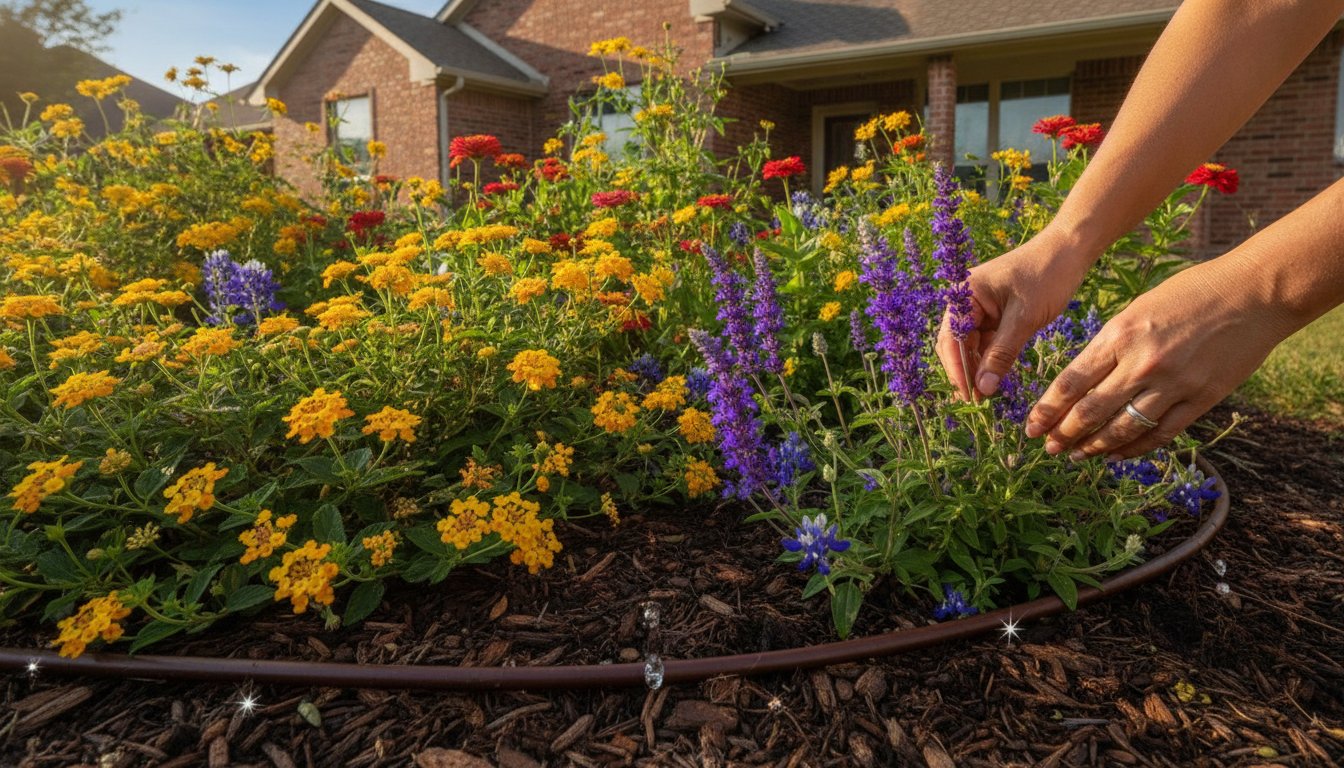
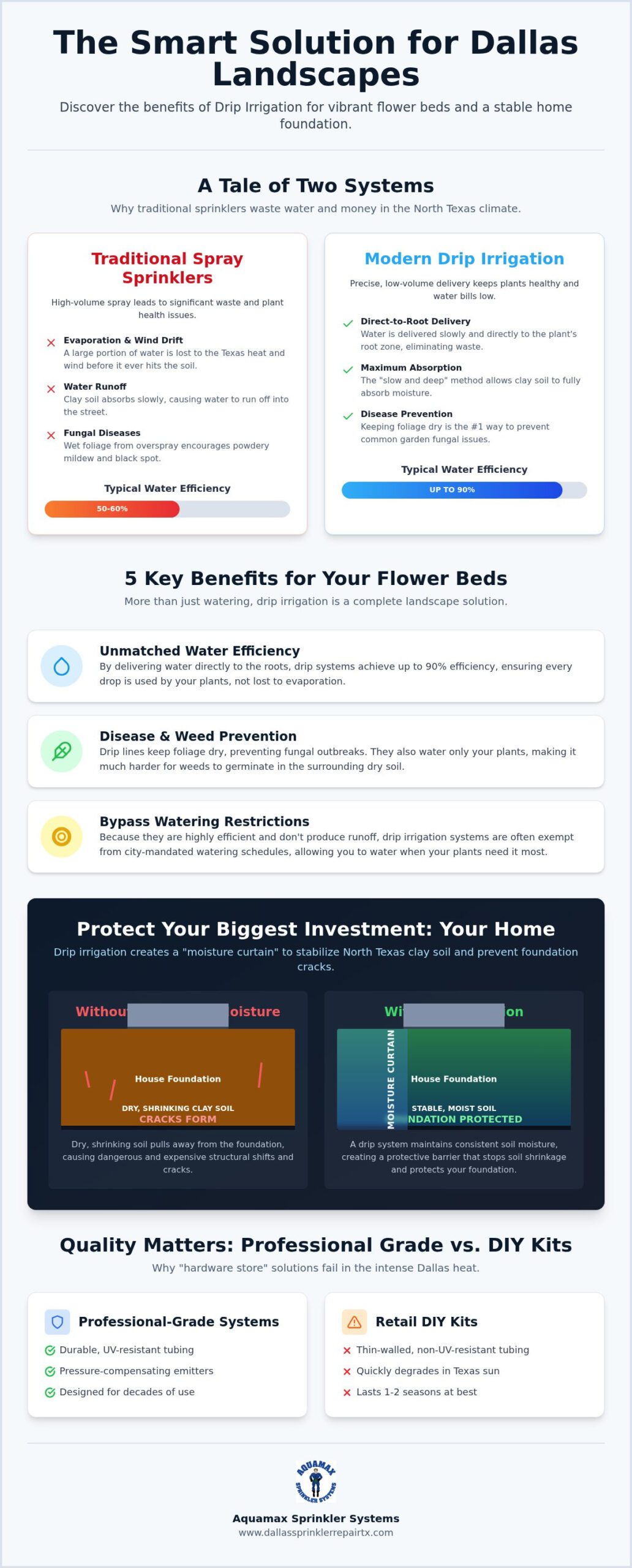
Traditional spray heads are notoriously inefficient in the North Texas climate. During a typical July afternoon, a significant portion of water from a sprinkler evaporates before it ever reaches the soil. Wind interference further complicates this; even a light breeze can blow the spray onto your driveway or siding. This “overspray” doesn’t just waste water. It can lead to fungal issues on foliage and uneven growth. One of the primary Benefits of drip irrigation for flower beds is that it eliminates these variables entirely. By delivering water beneath the mulch layer, you keep the leaves dry and the water exactly where it’s needed. This precision is why drip systems are up to 90% efficient, a stark contrast to the 50% or 60% efficiency typical of standard spray zones. Understanding the Benefits of drip irrigation for flower beds helps homeowners see why this is a necessary upgrade for the 2026 season.
The Role of Emitters and Tubing
The heart of any system lies in its emitters and tubing. Pressure-compensating emitters are vital for Dallas properties with uneven terrain or long flower beds. These components ensure that the last plant on the line receives the exact same amount of water as the first. We emphasize high-grade, UV-resistant polyethylene tubing because the intense Texas sun quickly destroys the thin-walled kits found at big-box retailers. Professional Drip irrigation installation utilizes industrial-strength components that are built to last for decades, not just a single season. This durability is essential for maintaining consistent performance in our harsh environment.
5 Key Benefits of Drip Irrigation for Your Flower Beds
Switching to a modern irrigation method is often a necessity rather than a luxury in North Texas. The extreme summer heat and volatile weather patterns demand a system that performs under pressure. Understanding the specific Benefits of drip irrigation for flower beds helps you see why this technology has become the gold standard for Dallas homeowners. It transforms your landscape from a high-maintenance burden into a thriving, efficient environment.
- Unmatched Water Efficiency: Traditional spray heads are often only 50% to 60% efficient due to wind drift and evaporation. Drip systems achieve up to 90% efficiency by delivering water directly to the soil, ensuring every drop you pay for actually reaches your plants.
- Disease Prevention: Many common Dallas garden issues, such as powdery mildew and black spot, thrive on wet foliage. Drip lines keep the leaves dry, significantly reducing the risk of fungal outbreaks that can devastate expensive ornamentals.
- Precision Weed Suppression: Sprinklers water everything, including the weed seeds in your mulch. Drip emitters only hydrate the root zones of your desired plants, leaving the surrounding soil dry and making it much harder for weeds to germinate.
- Significant Time Savings: Hand watering during a Dallas heatwave is a grueling daily chore. An automated drip system handles the work for you, operating on a precise schedule that ensures your garden never misses a cycle.
- Financial ROI: While there is an initial investment, the long-term savings are substantial. Lower monthly utility bills and the reduced cost of replacing dead plants mean the system often pays for itself. You can also Check for available service specials to make your upgrade even more cost-effective.
Sustainability and Local Compliance
Dallas water ordinances are strict, especially during drought stages. However, drip irrigation is often exempt from the time-of-day bans that limit traditional sprinklers. By eliminating runoff, you also prevent fertilizers and sediment from entering local storm drains. This supports broader xeriscaping goals and ensures your property remains a responsible part of the North Texas ecosystem while staying lush and green.
Superior Plant Health and Growth
Plants in clay soil often suffer through a “stress-and-recovery” cycle where they alternate between being waterlogged and bone-dry. Drip irrigation maintains consistent moisture levels, which stabilizes the plant’s environment. This consistency encourages deep root stimulation. When roots grow deeper into the soil to find moisture, the plants become naturally more resistant to the 100-degree days typical of August in North Texas. Additionally, these systems can be adapted for fertigation, allowing you to deliver liquid nutrients directly to the roots for more vibrant blooms.
Protecting Your Home: Drip Irrigation and Foundation Care
In North Texas, your foundation is only as stable as the soil surrounding it. Our regional Blackland Prairie clay is notorious for its expansive nature. It expands when saturated and shrinks significantly during our dry, triple-digit summers. This constant movement exerts immense pressure on concrete slabs. One of the most overlooked Benefits of drip irrigation for flower beds is the ability to stabilize this soil through a consistent moisture curtain.
By installing dedicated drip lines around the perimeter of your home, you maintain a stable soil volume. This prevents “subsidence,” where the soil pulls away from the foundation, and “heave,” where uneven watering causes parts of the slab to lift. Flower beds located adjacent to your home’s exterior walls are the most critical areas for this intervention. Without a controlled system, these zones often become dangerously dry or unevenly soaked. A precision system ensures the ground stays firm and the structural integrity of your home remains intact.
Integrating Flower Beds with Foundation Lines
A well-designed system serves a dual purpose. It provides the hydration your ornamentals need while acting as a structural safeguard. We typically place drip lines 12 to 18 inches from the slab to ensure the moisture reaches the foundation’s footprint without causing erosion. Monitoring soil moisture levels in these beds throughout the summer is essential. If you see the soil pulling away from the concrete, it’s a sign that your watering duration needs adjustment. This proactive approach is a vital part of property maintenance in Dallas. It ensures that the Benefits of drip irrigation for flower beds extend far beyond aesthetic appeal to protect your most significant financial investment. Maintaining this balance requires local expertise to ensure the lines are placed correctly for both your plants and your slab.
Stabilizing North Texas Soils
Clay soil acts like a sponge. When it dries, it develops deep fissures that allow subsequent heavy rains to bypass the surface and pool deep underground. This leads to structural cracking in brickwork and interior walls. Traditional sprinklers often exacerbate this problem by creating “wet spots” near the house while leaving other sections bone-dry. A professional Drip Irrigation for Foundation Care system eliminates these fluctuations. It delivers a slow, uniform application that keeps the clay in a perpetual state of moderate moisture. This prevents the damaging shrink-swell cycle that leads to thousands of dollars in repair costs.
Designing Your Drip System: Best Practices for Success
A successful drip system in North Texas is the result of deliberate engineering, not guesswork. You must account for the specific water requirements of your landscape while managing the high pressure typical of Dallas municipal lines. One of the primary Benefits of drip irrigation for flower beds is the ability to implement hydrozoning. This involves grouping plants with similar hydration needs on the same valve line. By separating drought-tolerant lantana from water-hungry hydrangeas, you ensure every plant thrives without wasting a drop. Precision is the standard here. Every gallon must be accounted for to stay within your utility budget.
Technical components like filtration and pressure regulation are non-negotiable. Dallas water pressure often exceeds the limits that drip emitters can handle. Without a regulator to step the pressure down to roughly 25 or 30 PSI, your emitters may pop off or fail prematurely. Similarly, a high-quality filter prevents the fine sediment found in our water from clogging the small orifices of your emitters. Integrating a smart controller with EPA WaterSense certification further optimizes this setup.
Maintenance and Winterization in Texas
Ongoing maintenance ensures your investment continues to pay off. You should flush your lines at least once a year to remove any accumulated mineral deposits or debris. This simple step prevents the emitter clogs that lead to dry spots and dying plants. Winterization is equally critical in North Texas. While our winters are generally mild, a “Blue Norther” can bring sudden, deep freezes that expand water inside your valves and pipes. Insulate your main backflow assembly and drain the lines before the first hard freeze hits. Finally, remember to adjust your controller run times as you move from the rainy spring into the peak of the July heat. A system that isn’t adjusted seasonally is a system that wastes money.
Step-by-Step Design Framework
Begin by mapping your flower bed to identify high-need and low-need zones. This map dictates your emitter spacing. For most Dallas ornamentals, 12-inch intervals are standard, though dense groundcovers may require 6-inch spacing for uniform coverage. You must then install the head assembly. This includes a backflow preventer to protect your home’s potable water, followed by the filter and regulator. If you want to ensure your system is engineered for maximum longevity, you can Schedule a professional sprinkler installation to get the hydraulics exactly right from the start.
Professional Installation vs. DIY: Why Local Expertise Matters
DIY drip kits often look like an easy weekend project on the retail shelf, but they frequently fail under the harsh conditions of North Texas. These “hardware store kits” typically feature thin-walled tubing that becomes brittle and cracks after just one season in the intense Dallas sun. Professional Drip Irrigation Installation utilizes commercial-grade, UV-resistant materials designed for decades of service. Beyond material quality, an experienced technician understands the complexities of hydraulic balancing. This engineering ensures that pressure remains consistent across the entire length of the flower bed. Without proper balancing, the plants closest to the water source often drown while those at the end of the line slowly wither from thirst.
Integrating a new drip zone into your existing sprinkler controller requires technical precision. It involves tapping into high-pressure PVC mainlines and installing specialized valves that won’t interfere with the hydraulics of your lawn’s spray heads. A professional installation provides long-term peace of mind through warranties and certified expertise. When a licensed specialist handles the work, you avoid the leaks, clogs, and pressure blowouts common in amateur attempts. Investing in professional labor ensures you actually realize the Benefits of drip irrigation for flower beds rather than spending your weekends troubleshooting a failing system.
Ready to Upgrade Your Landscape?
If your current flower beds still rely on old-fashioned spray heads, you are likely paying for water that never reaches your plants. A professional water audit can identify exactly where your system is failing and where runoff is damaging your foundation. Retrofitting these old zones is a straightforward process for our team. We can convert inefficient pop-up zones into modern, subsurface drip lines that satisfy both your plants and local water ordinances. This upgrade reduces your monthly utility costs while enhancing the vitality of your garden. Contact us today for a Custom drip irrigation quote and take the first step toward a thriving, low-maintenance landscape.
The Aquamax Advantage
Aquamax Sprinkler Systems has served the Dallas-Fort Worth area since 1998. With over 25 years of local experience, we have encountered every soil condition and landscape challenge the region offers. We use industrial-strength components that are not available in big-box stores, ensuring your system survives both the “Blue Norther” freezes and the record-breaking August heatwaves. Our experienced technicians prioritize system longevity and water conservation in every design. Explore Why Choose Aquamax for Your Irrigation Needs to see how our localized expertise translates into a more resilient property.
Secure Your Dallas Landscape for the 2026 Season
Maintaining a beautiful North Texas garden doesn’t have to mean fighting a losing battle against high utility bills and extreme heat. By moving beyond outdated spray heads, you gain precise control over your property’s hydration and structural health. The Benefits of drip irrigation for flower beds include significant water savings, disease prevention, and the essential stabilization of our expansive clay soils. This technology is your best defense against foundation damage and rising water rates. It’s a smart investment that pays for itself through lower monthly costs and healthier plants.
Aquamax Sprinkler Systems provides the local expertise needed to navigate these unique regional challenges. As an A+ rated local service since 1998, we specialize in custom designs for Dallas soil conditions. Our experienced technicians ensure your system is built for longevity and professional performance. Don’t let another summer of drought stress your ornamentals or your home’s foundation. We’re here to provide the peace of mind that comes with a professionally managed landscape.
Schedule Your Drip Irrigation Consultation with Aquamax Today to protect your investment and enjoy a lush, thriving landscape all year long. We are ready to help you achieve a more sustainable and beautiful North Texas home.
Frequently Asked Questions
Will drip irrigation attract pests like ants or rodents?
Drip irrigation actually discourages many pests by keeping the surface of your flower beds dry. Traditional sprinklers create puddles and high humidity that attract mosquitoes and other insects. Since drip lines deliver water beneath the mulch layer, there is no standing water for pests to find. Keeping your lines covered with a proper layer of mulch also protects the tubing from thirsty rodents.
What happens if a drip line gets a hole or a clog?
Repairs for drip lines are localized and straightforward. If a line is punctured by gardening tools, a technician can quickly install a coupling to bridge the gap. We install high-quality filters at the zone valve to prevent sediment from reaching the emitters. If a clog does occur, the specific emitter can usually be cleaned or replaced without affecting the rest of the line.
How often should I run my drip irrigation for flower beds in the summer?
You should run your drip system for longer durations but less frequently than a spray zone. During a typical Dallas July, running the system for 45 to 60 minutes twice a week is common. This allows the water to soak deep into the clay soil, encouraging deeper root growth and helping to stabilize the ground around your home’s foundation.
Is drip irrigation allowed during Dallas water restrictions?
Drip irrigation is currently exempt from the City of Dallas year-round twice-weekly watering schedule. While traditional automatic sprinklers are restricted to specific days and prohibited between 10 a.m. And 6 p.m., drip systems and soaker hoses are permitted on any day at any time. This exemption is one of the major Benefits of drip irrigation for flower beds during extreme drought conditions.
Can I convert my existing sprinkler heads to a drip system?
Yes, you can convert existing spray zones into drip zones through a process called retrofitting. This involves installing pressure-regulating adapters on your current risers and capping off unused heads. It allows you to keep your existing underground PVC pipes and controller while upgrading to a more efficient delivery method. It is a cost-effective way to modernize an older irrigation system.
Does drip irrigation require more maintenance than standard sprinklers?
Drip systems don’t necessarily require more maintenance, but the tasks are different. You should flush the lines at least once a year to clear out sediment and mineral deposits. Because the water delivery is at the soil level, you must occasionally check that mulch hasn’t buried emitters or that clogs haven’t formed. Professional-grade components significantly reduce the frequency of these repairs.
How much water can I actually save by switching flower beds to drip?
Homeowners can save between 35% and 80% on water usage by switching from conventional sprays to drip zones. Because these systems deliver water directly to the soil, they eliminate losses from evaporation and wind drift. In a climate where outdoor watering accounts for over half of summer utility bills, the Benefits of drip irrigation for flower beds include significant monthly savings.
Will drip irrigation work in my heavy Dallas clay soil?
Yes, drip irrigation is the most effective method for managing heavy North Texas clay. This soil type absorbs water at a very slow rate. Traditional sprinklers often deliver water faster than the clay can intake it, leading to wasteful runoff. Drip systems release moisture slowly, allowing it to penetrate deep into the root zone without saturating the surface or causing erosion.