


Article by
Robert Maxvill
Owner of Aquamax Sprinkler Systems, American Sprinkler Repair and Dallas Drainage Systems.
You step outside on a 100-degree Dallas afternoon only to find your expensive St. Augustine grass turning a brittle, dusty brown. You check your irrigation heads, but instead of a powerful spray, they’re barely bubbling over the top. It’s a common frustration for North Texas homeowners who see their water bills rise while their curb appeal vanishes. You might wonder if the city’s municipal supply is to blame, but the issue usually lies within the system’s own components or the shifting clay soil beneath your feet.
Learning how to fix low water pressure in sprinkler system units is essential for maintaining a healthy lawn without wasting resources. Whether you’re dealing with a single clogged nozzle or a major underground leak, a systematic approach saves time and money. This guide provides the professional expertise you need to diagnose the problem accurately. We will walk you through a step-by-step process to restore full head pop-up and even coverage. From cleaning debris out of filters to identifying the pipe breaks caused by our region’s volatile soil, you’ll learn how to ensure your system is leak-free and efficient before the next heatwave hits.
Key Takeaways
- Differentiate between city-wide water issues and system-specific failures by checking your static pressure at an outdoor hose bib.
- Inspect the backflow preventer and main shut-off valves to ensure they are fully open, which is a critical first step in how to fix low water pressure in sprinkler system configurations.
- Recognize how the unique “shrink-swell” cycle of North Texas clay soil can snap underground PVC joints and create hidden leaks.
- Use the “squish test” and look for suspiciously green patches of grass to locate silent pipe breaks that divert water away from your sprinkler heads.
- Evaluate the benefits of professional irrigation audits and pressure-regulating heads to maintain consistent coverage despite fluctuating municipal water standards.
Table of Contents
Is it the Whole System or One Zone? Initial Pressure Diagnosis
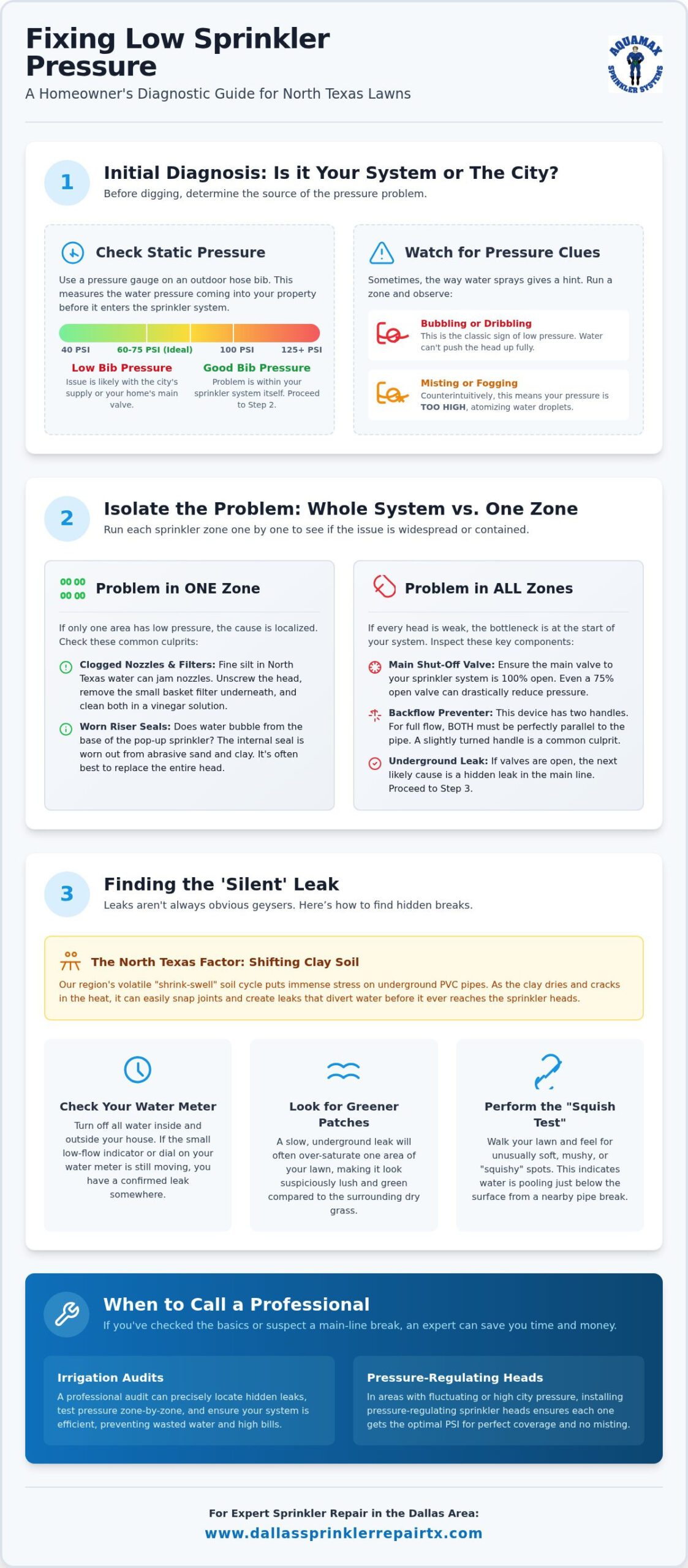
Before you start digging up your yard, you must determine the scope of the failure. Most homeowners assume a massive leak is the culprit, but the reality is often simpler. Start by checking your “Static Pressure” at an outdoor hose bib using a standard pressure gauge. In the Dallas-Fort Worth area, municipal pressure can reach up to 125 psi, though the ideal residential range is 60 to 75 psi. If your hose bib shows healthy pressure but your sprinklers are struggling, the problem is inside your irrigation system. If the bib pressure is low, the issue likely resides with the city supply or your home’s main pressure reducing valve.
Next, run each zone individually. If the pressure drop only occurs in one specific area, you are likely dealing with a localized issue such as a clogged filter or a cracked lateral line. However, if every head across your entire property is barely popping up, the bottleneck is at the beginning of the system. This often points toward the backflow preventer or the main shut-off valve. For these complex main-line issues, a professional Irrigation repair specialist can quickly isolate the fault without unnecessary excavation.
Understanding How irrigation sprinklers work is vital because sometimes what looks like “low pressure” is actually the opposite. If you see a fine mist or fog drifting away in the wind, your pressure is actually too high. High pressure atomizes the water, preventing the heavy droplets needed for deep soil penetration. This creates the illusion of poor coverage. If you don’t see misting, perform a “silent leak” test. Ensure all water inside the house is off and check your water meter. If the low-flow indicator or dial is moving while the sprinkler system is off, you have a confirmed leak in your main line. This is a critical step in learning how to fix low water pressure in sprinkler system setups before the Texas heat causes permanent damage to your lawn.
Inspecting for Worn Riser Seals
Perform the “Wobble Test” by gently shaking the pop-up riser while it’s active. If water is bubbling out from the neck of the head rather than the nozzle, the internal seal is shot. In our region, the abrasive clay and sand act like sandpaper on these seals every time they move. If the seal is worn, it’s usually more cost-effective to replace the entire head rather than trying to rebuild the internal components, as the outer casing is often just as weathered.
Cleaning Clogged Nozzles and Filters
The fine silt found in North Texas water supplies can easily jam high-efficiency nozzles. If a single head is performing poorly, unscrew the nozzle and remove the small plastic basket filter located underneath. Soak these parts in a mild vinegar solution to dissolve mineral deposits and flush the riser by briefly turning on the zone while the nozzle is removed. This simple maintenance often restores full flow instantly without requiring any new parts.
Checking the Mechanical Culprits: Valves and Backflow Preventers
When your initial diagnosis points to a system-wide issue, the bottleneck is usually mechanical. The first place to look is your main shut-off valve. Sometimes, these valves are accidentally bumped or only partially reopened after a plumbing repair. A valve that is only 75% open can significantly throttle your flow, creating a massive drop in dynamic pressure once the heads pop up. Ensure the main gate or ball valve is turned completely to the “on” position to restore full volume to the mainline.
Next, inspect your backflow preventer. This device is the gatekeeper between your home’s clean water and the irrigation lines. It typically features two shut-off handles. For maximum flow, both handles must be perfectly parallel to the pipe. If even one handle is slightly turned at an angle, it restricts the water passage. Homeowners often find that troubleshooting water pressure starts with these simple manual adjustments. If you hear a loud thumping or vibrating sound when the system starts, known as water hammer, it may indicate a failing internal component within the backflow assembly or a loose valve seat that requires professional attention.
A failing master valve is another common culprit for a slow, system-wide decline in performance. Because the master valve opens every time any zone is activated, it experiences the most wear. If the internal spring or solenoid begins to fail, the valve may not open fully, starving every zone of the pressure it needs. Identifying these mechanical failures is a vital part of knowing how to fix low water pressure in sprinkler system setups before the summer heat peaks.
The Role of the Pressure Regulator
In many DFW neighborhoods, municipal pressure is high enough that the Dallas Plumbing Code requires a Pressure Reducing Valve (PRV) if the static pressure exceeds 80 psi. If your PRV fails, it can either spike your pressure or drop it to a trickle. If you notice erratic pressure or sudden “surging” at the heads, your regulator may need adjustment or replacement. Our team has helped many neighbors restore their systems; you can see the results of our expertise in our Customer reviews.
Diagnosing Zone Valve Diaphragm Failures
Inside every zone valve is a flexible rubber diaphragm. Over time, North Texas water minerals or small pebbles can cause tiny tears or build-up on this seal. A damaged diaphragm might cause a “weeping” valve, where water constantly leaks from the heads even when the system is off, or it may prevent the valve from opening completely. Because these components are under constant pressure and involve complex spring assemblies, you should leave valve disassembly to a Licensed irrigation repair specialist to avoid flooding your valve box.
The North Texas Factor: Shifting Clay Soil and Pipe Damage
The heavy clay of the Blackland Prairie is the most significant obstacle to irrigation longevity in Dallas and Plano. This soil is famous for its “shrink-swell” cycle. During wet periods, the clay expands with immense force; during droughts, it contracts, leaving deep fissures in the earth. This constant movement places massive physical stress on underground PVC joints. Over time, these joints snap or pull apart as the earth shifts beneath your lawn. If you are researching how to fix low water pressure in sprinkler system units, you cannot ignore the ground itself. The soil is not a static platform; it’s a moving force that actively works against your infrastructure.
Foundation shifting is another local reality that directly impacts your water pressure. When your home’s foundation moves, the irrigation main line, which is often buried near the perimeter, moves with it. This can shear pipes right at the point where they enter the valve box or connect to the house. Additionally, many older systems were installed by “solar cowboys.” These were unlicensed contractors who took shortcuts 20 or 30 years ago. These legacy systems often feature thin-walled piping or shallow trenches that are now failing under the pressure of North Texas’s shifting terrain. Tree roots from mature oaks and elms further complicate the issue, as they seek out the moisture in your lines and eventually “strangle” the pipes, reducing flow to a trickle.
The Impact of Record-Breaking DFW Heat
Extreme ground temperatures, particularly during an August heat dome, can weaken aged PVC. When the soil dries out and cracks, it removes the support structure from around the pipe. The pipe then bows under its own weight and the internal water pressure. This makes a comprehensive Sprinkler system tune-up essential after any significant Texas drought. Catching these structural weaknesses early prevents a minor pressure drop from becoming a catastrophic main line burst that floods your landscape and sends your water bill skyrocketing.
Recognizing Soil-Related Pipe Compression
A pipe doesn’t always have to be shattered to fail. In dense clay, a pipe can be “pinched” or compressed by the weight of the shifting earth or encroaching tree roots. If you notice one head works perfectly but the next three in the line are dead, you likely have a constriction. Large roots are notorious for wrapping around lines and slowly squeezing them shut. Interestingly, professionally installed Drainage systems can mitigate this by stabilizing the moisture levels in the soil. This prevents the extreme expansion and contraction that leads to pipe damage in the first place.
Finding the ‘Silent’ Leak: Locating Underground Breaks
If your valves are open and your nozzles are clean but the spray remains weak, you are likely losing water to an underground breach. Locating these “silent” leaks requires a methodical approach. Start with the “Squish” test. Walk along the path of your irrigation lines while the system is running. If you step on a spot that feels unusually soft, spongy, or muddy compared to the rest of the yard, you’ve likely found a break. Because North Texas clay can be dense, water doesn’t always pool on the surface immediately; it may travel along the pipe before finding a way up.
Another reliable indicator is “The Oasis.” Look for a patch of grass that is suspiciously greener, taller, or more vibrant than the surrounding turf. While the rest of your lawn suffers from low pressure, this specific area is thriving on a constant subterranean water source. In more advanced stages of a leak, you might notice small sinkholes or soil depressions. This occurs when the escaping water washes away the subsoil, creating a void beneath the grass. To confirm your suspicions, use a metal probing rod to feel for saturated soil about 12 inches below the surface. If the rod slides into the earth with little resistance, you’ve identified the leak’s epicenter. Mastering these detection techniques is a vital part of learning how to fix low water pressure in sprinkler system configurations before they cause structural damage.
Repairing a PVC Break
For homeowners attempting a DIY fix, a “Slip-Fix” telescopic coupling is often more manageable than a standard coupling. It allows you to bridge the gap in a broken pipe without having to forcefully bend the PVC to fit a rigid connector. However, the quality of your primer and solvent cement is non-negotiable. Our local systems face high municipal pressure and shifting soil, so you must use a heavy-duty, fast-setting cement to ensure the bond holds. If you discover a break located within two feet of a mature tree or your home’s foundation, the repair requires specialized care to avoid further damage to your property’s infrastructure.
DIY Leak Detection vs. Professional Equipment
Digging blindly in your yard is a significant risk. Without knowing exactly where your utility lines are buried, you could accidentally cut a gas line or an internet cable. Professional technicians use sonic leak detection equipment to “hear” the high-frequency vibrations of water escaping a pressurized pipe through several feet of earth. We also utilize a “Zone Isolation” method. By temporarily capping the heads in a failing zone, we can determine if the pressure loss is coming from the lateral lines or a more complex manifold issue. If you’re tired of guessing where the water is going, schedule a professional Irrigation repair to pinpoint the problem with precision.
Professional Solutions: Restoring Pressure and Efficiency
A professional irrigation audit is the fastest way to stop wasting water and money on a failing system. While basic troubleshooting identifies obvious breaks, an expert evaluation uncovers the subtle inefficiencies that lead to “lazy” heads and dry patches. We utilize over 25 years of local data to determine exactly how to fix low water pressure in sprinkler system setups across the DFW Metroplex. One of the most effective upgrades is the installation of pressure-regulating heads (PRS). Since municipal water pressure in Dallas can fluctuate wildly or reach levels as high as 125 psi, PRS heads ensure each nozzle operates at its ideal 30 to 40 psi. This prevents the misting mentioned in earlier sections and ensures that water actually reaches the roots of your grass.
Modern smart controllers offer a significant return on investment. These systems don’t just follow a timer; they adjust for real-time weather conditions and local pressure fluctuations. By maintaining consistent delivery, you reduce the physical stress on your PVC joints and valves. Since 1998, Aquamax Sprinkler Systems has focused on these high-efficiency repairs to future-proof North Texas lawns against our increasingly volatile climate. This proactive approach transforms a struggling system into a vital asset for your property’s aesthetic and environmental health.
Preventing Future Pressure Drops
Consistency is the key to irrigation longevity. A “Spring Start-Up” checklist is essential for every homeowner. This includes testing every zone, cleaning all filters, and verifying that the backflow preventer is fully operational. Clogged filters are the leading cause of poor head performance. A quick cleaning can prevent a minor obstruction from becoming a major headache. If you notice a decline in performance that doesn’t respond to basic cleaning, schedule a professional Sprinkler repair in Dallas immediately. Catching a leak or a failing valve early protects your expensive sod and ensures your monthly water bills remain manageable.
Modernizing an Aging Irrigation System
In established neighborhoods like Highland Park, many 20-year-old systems require more than just a simple patch. The thin-walled piping used in legacy installations often cannot handle modern pressure demands or the weight of maturing tree roots. Converting struggling low-pressure zones to Drip irrigation is a superior solution for foundation health and water conservation. Drip lines deliver water directly to the soil at a fraction of the pressure required by traditional pop-ups. This modernization, combined with new high-efficiency nozzle technology, allows your system to provide better coverage with significantly less required pressure.
Protect Your Landscape with Professional Irrigation Care
Identifying the root cause of poor irrigation performance is the first step toward reclaiming a healthy landscape. You’ve learned how to differentiate between municipal supply issues and internal mechanical failures, such as damaged backflow preventers or pipes pinched by shifting clay soil. Knowing How to fix low water pressure in sprinkler system units involves more than just a quick patch; it requires a commitment to long-term efficiency and structural integrity. Finding the balance between city-side pressure and home-side delivery is essential for a thriving yard.
As licensed DFW irrigation experts since 1998, Aquamax Sprinkler Systems brings specialized leak detection technology and an A+ BBB rating to every repair. We understand the unique environmental pressures of Dallas, Plano, and Frisco. We are ready to help you stop the waste and restore your curb appeal immediately. Don’t let a hidden leak or a worn-out valve destroy your expensive sod or foundation health.
Schedule a Professional Sprinkler Pressure Diagnostic with Aquamax to ensure your system is ready for the next Texas summer. Your lawn is a vital part of your home’s value and beauty. With professional care, you can enjoy a lush, green property without the stress of rising water bills or dying grass.
Frequently Asked Questions
Why are my sprinkler heads barely popping up even though the water is on?
This is the most common sign when homeowners research how to fix low water pressure in sprinkler system units. The system cannot build enough head pressure to lift the risers against their internal springs. You’re either losing water through an underground break or the volume entering the system is being throttled by a malfunctioning master valve or backflow preventer. Worn-out riser seals can also bleed off enough pressure to prevent the heads from popping up fully.
Can I fix low sprinkler pressure myself without digging?
Identifying how to fix low water pressure in sprinkler system units often begins with simple, non-invasive checks. You can clean clogged nozzles or verify that your main shut-off valves are fully open without any excavation. These steps frequently resolve issues caused by silt or accidental valve adjustments. If the pressure doesn’t improve, you’re likely dealing with an underground break or a mechanical failure that requires professional detection equipment.
How much does it cost to fix low water pressure in a sprinkler system in Dallas?
The cost of repairs depends entirely on the source of the pressure loss. A simple nozzle replacement is a minor expense, whereas repairing a main line break beneath a driveway or mature tree involves more labor and equipment. A professional diagnostic provides the most accurate assessment. This ensures you only pay for the specific repairs your system needs to function efficiently. Factors like the number of zones and leak depth also play a role.
Is it possible for tree roots to crush my irrigation pipes?
Tree roots are a major factor in North Texas irrigation failures. As oaks and elms mature, their roots can grow around PVC pipes and slowly compress them. This strangulation doesn’t always cause a leak right away, but it significantly restricts water flow. You’ll notice a gradual decline in pressure that often puzzles homeowners until the pipe finally snaps. This is common in older neighborhoods with established landscaping.
Will a broken sprinkler head affect the pressure of the entire zone?
A single broken head can ruin the pressure for every other head on that zone. Water takes the path of least resistance, so a cracked head body or a missing nozzle acts like an open faucet. This diverts the volume needed to push the other heads up. Replacing the damaged head usually restores the entire zone’s performance immediately. It’s one of the simplest ways to fix a sudden drop in spray distance.
How do I know if my backflow preventer is causing low pressure?
Your backflow preventer might be the cause if the shut-off handles aren’t fully open. These handles must be perfectly parallel to the pipe to allow maximum flow. If the handles are correctly positioned but the device makes a loud vibrating sound, internal components may be obstructed. This requires a licensed professional to disassemble and repair the assembly safely to ensure your home’s water supply remains protected.
Can a dirty filter cause low water pressure in my sprinklers?
A dirty filter is a very common culprit for poor spray performance. Silt and mineral deposits from the DFW water supply get trapped in the small plastic basket beneath the nozzle. This creates a bottleneck that reduces flow. Removing the nozzle and rinsing the filter screen is a quick, effective way to restore pressure without digging. Regular maintenance of these screens prevents your heads from becoming “lazy” over time.
Why is my sprinkler pressure low in only one zone?
Low pressure in a single zone usually indicates a localized issue like a torn valve diaphragm or a crushed lateral pipe. If the other zones operate at full strength, your main line and backflow assembly are functioning correctly. Focus your inspection on the specific valve box for that zone and look for soggy patches along that specific line’s path. These symptoms often point to a leak that is unique to that area of your yard.