

Article by
Robert Maxvill
Owner of Aquamax Sprinkler Systems, American Sprinkler Repair and Dallas Drainage Systems.
Watering your lawn in the middle of a scorching Dallas afternoon feels productive. In reality, it could be quietly killing your grass. Timing matters far more than most homeowners realize, and finding the best time to water can mean the difference between a patchy, stressed yard and a thick, green lawn that holds up through the Texas heat.
If you’ve ever stood over your sprinkler controller wondering whether you’re doing more harm than good, you’re not alone. Dallas homeowners face a unique challenge: intense summer temperatures, clay-heavy soils, and water restrictions that make every drop count. Getting your watering schedule wrong doesn’t just hurt your lawn’s appearance, it drives up your water bill and puts your landscape under unnecessary stress.
This guide cuts through the confusion. You’ll learn exactly when to run your sprinklers, how Dallas’s climate shapes the right approach, and what simple adjustments can help your lawn thrive while keeping your water use efficient. Whether you’re managing an existing irrigation system or thinking about upgrading your setup, the answers start here.
Key Takeaways
- The best time to water your lawn in Dallas is early morning, when cooler temperatures and lower wind speeds allow moisture to reach roots before evaporation sets in.
- Dallas’s clay-heavy soils and intense summer heat require a watering schedule tailored to local conditions—what works in other regions can actively harm your lawn here.
- Plant biology plays a direct role in how effectively your lawn absorbs water, and understanding this can help you reduce waste while improving turf health.
- A personalized watering schedule, supported by soil moisture monitoring tools, takes the guesswork out of irrigation and protects your lawn through every season.
- A properly calibrated sprinkler system is one of the most reliable ways to deliver the right amount of water at the right time, without overwatering or missing critical areas.
Table of Contents
Understanding the Best Time to Water Your Lawn in Dallas
Dallas doesn’t play by standard lawn care rules. With summer temperatures regularly pushing past 100°F, clay-heavy soils that compact and crack, and a semi-arid climate that swings between drought and downpour, your watering schedule needs to reflect local reality, not generic advice written for cooler, wetter regions. The best time to water your lawn here is a specific window, not a rough guideline, and getting it right has a direct impact on how your turf performs through the brutal Texas summer.
When to Avoid Watering
Two windows consistently cause problems for Dallas homeowners:
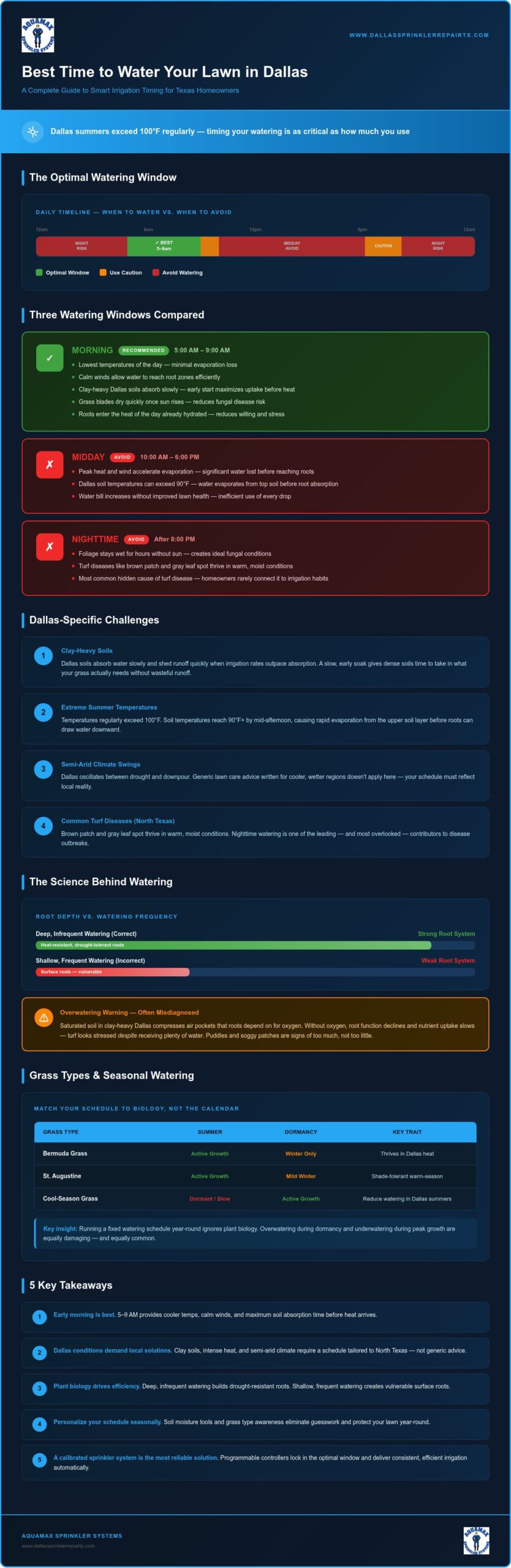
- Midday (10:00 a.m. To 6:00 p.m.): Heat and wind accelerate evaporation before water reaches root depth. You’re running your system and losing a significant portion of it before it does any real work.
- Nighttime (after 8:00 p.m.): Foliage stays wet for hours in the absence of sun. That prolonged moisture creates ideal conditions for fungal disease, particularly during Dallas’s humid summer nights. Nighttime watering is one of the most common contributors to turf disease problems that homeowners don’t immediately connect to their irrigation habits.
A properly timed Sprinkler system removes the guesswork entirely. Programmable controllers let you lock in that early morning window so your lawn gets consistent, efficient irrigation without you having to think about it each day. That consistency, paired with the right timing, is what separates a thriving Dallas lawn from one that’s constantly struggling to recover.
Why Morning Watering is Preferred
The optimal window for watering in Dallas is between 5:00 a.m. And 9:00 a.m. During these hours, temperatures are at their lowest, wind speeds are typically calm, and your soil has the maximum opportunity to absorb moisture before the heat arrives. This matters especially with Dallas’s clay-dominant soils, which absorb water slowly and can shed runoff quickly if irrigation rates outpace absorption. A slow, early soak gives those dense soils time to take in what your grass actually needs.
There’s also a plant biology argument for morning watering. Grass blades dry off quickly once the sun rises, which keeps the surface conditions unfavorable for fungal growth. Turf diseases like brown patch and gray leaf spot, both common in North Texas, thrive in warm, moist conditions. Watering early reduces the window of wet foliage and cuts the risk significantly.
Your lawn also enters the day’s heat better prepared. Roots that have absorbed morning moisture are more resilient under afternoon stress, reducing the wilting and dormancy that often get misread as signs of underwatering.
The Science Behind Watering Times: How It Affects Lawn Health
Timing your irrigation isn’t just a scheduling preference. It’s a biological decision. Your lawn’s root system, soil chemistry, and nutrient uptake all respond differently depending on when water enters the equation, and understanding that relationship helps you make every watering cycle count.
Water Conservation Benefits
Proper timing directly reduces water waste. Early morning watering, with lower wind speeds and cooler air temperatures, delivers more moisture to the root zone per gallon applied than midday irrigation. This efficiency matters in a city like Dallas, where the Local water district periodically enforces seasonal watering restrictions to manage municipal supply during drought conditions. Staying within approved schedules isn’t just environmentally responsible; it keeps you compliant and avoids potential fines.
Eco-conscious lawn care also means calibrating your system to match actual soil moisture rather than running on a fixed timer regardless of recent rainfall. Soil moisture sensors and rain shutoff devices are practical tools that prevent unnecessary cycles. A well-timed Irrigation system tuned to local conditions consistently outperforms manual guesswork on both water efficiency and turf health.
Understanding Plant Needs
Grass roots absorb water through a process driven by soil moisture gradients. When the surrounding soil holds adequate moisture, roots extend deeper in search of it, building a more resilient structure that withstands heat stress. Shallow, frequent watering encourages roots to stay near the surface, where they’re most vulnerable to temperature extremes and drought.
Soil temperature plays a significant role here. In Dallas, soil temperatures during summer months can exceed 90°F by mid-afternoon. At those temperatures, water evaporates rapidly from the upper soil layer before roots can draw it down. Cooler morning soil retains moisture longer, giving roots a full absorption window before heat drives evaporation upward through the profile.
Seasonal variation matters too. Cool-season grasses slow their uptake during peak summer dormancy, while warm-season varieties like Bermuda and St. Augustine actively grow through the heat. Matching your watering frequency to these biological rhythms, rather than running a fixed schedule year-round, prevents both underwatering during growth phases and overwatering during dormancy.
Overwatering is a frequently underestimated problem. Saturated soil compresses air pockets that roots depend on for oxygen exchange. Without adequate oxygen, root function declines, nutrient uptake slows, and turf becomes visibly stressed despite receiving plenty of water. In Dallas’s clay soils, which drain slowly by nature, this problem compounds quickly. Puddles and soggy patches aren’t signs of a healthy lawn; they’re signs of a system that’s delivering more than the soil can process.
Nutrient absorption is also time-sensitive. Nitrogen, potassium, and phosphorus move into root zones through soil water. When you water at the best time to water, early morning, those nutrients travel efficiently into the root zone before soil temperatures climb. Midday watering disrupts this process; rapid evaporation concentrates salts near the surface rather than moving nutrients downward where roots can access them.
Setting Up an Effective Watering Schedule for Your Lawn
Knowing the best time to water is only half the equation. The other half is building a consistent, adaptable schedule that responds to what your lawn actually needs rather than running on autopilot regardless of conditions. A personalized watering plan accounts for your grass type, soil behavior, and the dramatic seasonal shifts that define Dallas’s climate throughout the year.
Monitoring and Adjusting Your Lawn’s Needs
Your lawn communicates clearly when something’s off. Recognizing those signals early prevents minor stress from becoming significant damage.
Signs your lawn needs more water include a blue-gray tint to the grass blades, footprints that remain visible long after you’ve walked across the turf, and leaf blades that fold or curl lengthwise. Signs of overwatering are equally readable: persistent soggy patches, a spongy feel underfoot, yellowing despite regular irrigation, and an uptick in fungal activity like mushrooms or discolored rings.
Soil moisture meters take the guesswork out of these assessments. A basic probe-style meter, inserted a few inches into the soil, gives you a direct reading of moisture at root depth rather than relying on surface conditions that can be misleading after a hot afternoon. Check multiple zones across your yard since clay soils in Dallas can hold moisture unevenly.
Smart irrigation controllers go a step further. These systems connect to local weather data and adjust run times automatically based on evapotranspiration rates, soil type, and plant water demand. For Dallas homeowners managing large yards or complex irrigation zones, the efficiency gains are substantial and the reduction in manual oversight is immediate.
Schedule a seasonal check-in with a qualified irrigation specialist to verify that your system’s output matches your lawn’s current needs. A professional Sprinkler system tune-up can identify coverage gaps, clogged heads, and pressure inconsistencies that silently undermine even the best-timed schedule. Aquamax Sprinkler Systems has been serving Dallas homeowners since 1998 with experienced technicians who understand local soil and climate conditions firsthand. When your schedule is dialed in and your system is performing correctly, your lawn stops being a source of stress and starts taking care of itself. Contact the team to get your irrigation setup working as efficiently as your schedule demands.
Creating Your Watering Schedule
Start by matching your schedule to the season, not just the calendar. Dallas lawns have distinct phases that demand different approaches:
- Spring (March to May): Warm-season grasses like Bermuda and St. Augustine are breaking dormancy and actively establishing root systems. Water two to three times per week, applying roughly one inch total across those sessions.
- Summer (June to September): Peak heat demands the most consistent irrigation. Three times per week is a reasonable baseline, though extended drought stretches may require adjusting frequency rather than run time. Longer, less frequent cycles encourage deeper rooting.
- Fall (October to November): Growth slows as temperatures drop. Reduce watering to once or twice weekly and monitor soil moisture closely. Overwatering during this transition is a common mistake that weakens root systems heading into winter.
- Winter (December to February): Most warm-season grasses are dormant. Watering once every two to three weeks is typically sufficient unless an extended dry spell occurs.
Weather forecasts are a practical tool that most homeowners underuse. Before scheduling a cycle, check the three-day outlook. A predicted half-inch of rain is enough to skip a session entirely. Many programmable controllers now include a rain delay feature; use it. Setting your sprinkler timer to run in that early morning window and enabling automatic rain delays is one of the simplest upgrades you can make to your irrigation routine.
Put Your Lawn on the Right Schedule Starting Today
A thriving Dallas lawn isn’t the result of watering more. It’s the result of watering smarter. The best time to water falls in that early morning window before heat and wind work against you, and pairing that timing with a season-adjusted schedule gives your turf the foundation it needs to stay healthy through even the harshest Texas summers.
The details matter: your soil type, your grass variety, your system’s coverage, and how well your controller responds to changing conditions. Get those elements working together, and your lawn stops struggling and starts performing.
Aquamax Sprinkler Systems has helped Dallas homeowners build efficient, reliable irrigation setups since 1998. Their experienced technicians understand the specific demands of local soils and climate, so every recommendation is grounded in real-world experience, not generic advice.
Don’t leave your lawn’s health to guesswork. Contact Aquamax Sprinkler Systems for a professional irrigation consultation and get your system dialed in before the next heat wave arrives. Your lawn is worth the investment.
Frequently Asked Questions
What is the ideal amount of water for my lawn?
Most Dallas lawns need roughly one inch of water per week during active growing seasons, delivered in fewer, deeper sessions rather than short, frequent ones. Deeper watering encourages roots to extend further into the soil profile, building drought resilience over time. A simple way to measure output is placing a shallow container in your yard during a watering cycle and timing how long it takes to collect one inch. Adjust your run time accordingly.
How can I conserve water while watering my lawn?
Timing is your most effective conservation tool. Watering early in the morning reduces evaporation loss compared to midday irrigation. Beyond timing, installing a rain shutoff device or soil moisture sensor prevents your system from running after rainfall or when the ground is already adequately hydrated. Checking your local water district’s seasonal restrictions and staying compliant also keeps your usage aligned with municipal conservation goals.
Is it better to use a sprinkler or a hose?
A properly installed sprinkler system consistently outperforms hand-watering with a hose. Sprinkler systems deliver water evenly across all zones, can be programmed to run during the optimal early morning window, and can be equipped with rain sensors and smart controllers that adjust output based on weather conditions. Hand-watering tends to be uneven, time-consuming, and difficult to schedule consistently, which leads to patchy results over time.
What are the signs of overwatering?
Overwatering is easier to miss than most homeowners expect. Watch for persistent soggy patches, a spongy feel when walking across the turf, yellowing grass despite regular irrigation, and fungal growth like mushrooms or discolored rings. In Dallas’s clay soils, which drain slowly, saturated conditions deprive roots of the oxygen they need to function, causing visible stress that can be mistaken for underwatering.
How often should I water my lawn in Dallas?
Frequency depends on the season. During peak summer months, watering two to three times per week is a reasonable baseline for warm-season grasses like Bermuda and St. Augustine. In spring and fall, once or twice weekly is typically sufficient. Winter-dormant lawns rarely need more than one session every two to three weeks. Always factor in recent rainfall before running a cycle.
Can I water my lawn at night?
Nighttime watering is one of the most damaging habits for Dallas lawns. Without sunlight to dry the grass blades, foliage stays wet for hours, creating ideal conditions for fungal diseases like brown patch and gray leaf spot. Both are common in North Texas and spread quickly in warm, moist environments. If your schedule makes early morning watering difficult, a programmable irrigation controller solves the problem automatically.
What is the best time of day to water my lawn?
The best time to water your lawn is between 5:00 a.m. And 9:00 a.m. During this window, air temperatures are cooler, wind speeds are lower, and soil conditions allow moisture to penetrate effectively before the day’s heat arrives. This is especially important in Dallas, where afternoon temperatures can push past 100°F and evaporate surface moisture before it reaches root depth.