
Article by
Robert Maxvill
Owner of Aquamax Sprinkler Systems, American Sprinkler Repair and Dallas Drainage Systems.
Your commercial property’s sprinkler system isn’t just watering grass; it’s either protecting your investment or quietly destroying it. Inefficient commercial sprinkler system design is one of the most overlooked sources of inflated utility bills, foundation damage, and slip-and-fall liability on North Texas properties. If you’ve ever watched water pool along a sidewalk, noticed dry patches despite a running system, or opened a water bill that made you wince, you already know something is wrong.
That frustration is valid. Commercial irrigation in DFW isn’t a simple plug-and-play task. North Texas clay soil expands and contracts with moisture, water pressure varies across large properties, and local municipalities enforce tiered restriction schedules that a poorly designed system will violate without warning. Getting it right requires precision engineering, not guesswork.
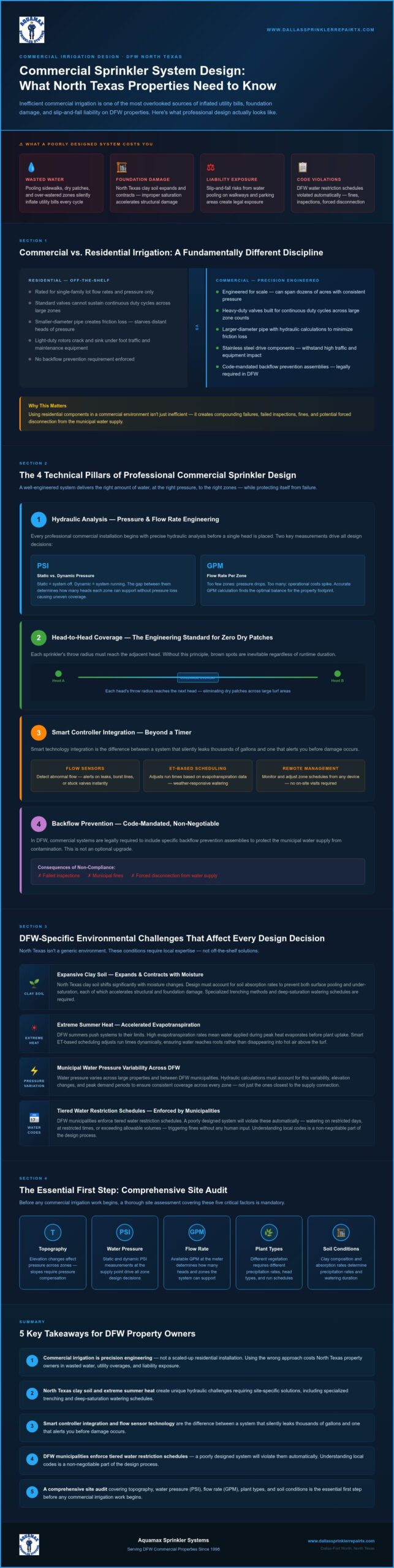
This guide breaks down exactly how professional commercial irrigation design works in the DFW market. You’ll learn the hydraulic principles behind true head-to-head coverage, how to align your system with local water codes, and what smart technology integration actually looks like in practice. Whether you’re evaluating a legacy system or planning a new installation, what follows is the blueprint you need.
Key Takeaways
- Professional commercial sprinkler system design is a precision engineering process—not a scaled-up version of residential installation—and using the wrong approach costs North Texas property owners in wasted water, utility overages, and liability exposure.
- North Texas clay soil and extreme summer heat create unique hydraulic challenges that require site-specific solutions, including specialized trenching methods and deep-saturation watering schedules.
- Smart controller integration and flow sensor technology are the difference between a system that silently leaks thousands of gallons and one that alerts you to a problem before damage occurs.
- DFW municipalities enforce tiered water restriction schedules, and a poorly designed system will violate them automatically—understanding local codes is a non-negotiable part of the design process.
- A comprehensive site audit covering topography, water pressure (PSI), flow rate (GPM), and plant types is the essential first step before any commercial irrigation work begins.
Understanding Commercial Irrigation vs. Residential Sprinkler Design
Commercial irrigation design is a fundamentally different discipline from residential sprinkler installation. It’s a high-capacity water distribution network engineered for scale, durability, and regulatory compliance across properties that can span dozens of acres. Understanding that distinction isn’t academic; it’s the difference between a system that performs reliably for decades and one that fails within its first Texas summer.
Residential “off-the-shelf” components are rated for the flow rates and pressure demands of a single-family lot. Drop them into a commercial environment and the problems compound quickly. Standard residential valves can’t sustain the continuous duty cycles required across large zones. Smaller-diameter pipe creates friction loss that starves distant heads of adequate pressure. And residential-grade rotors, designed for light residential traffic, crack and sink under the foot traffic and maintenance equipment common on commercial properties. The components simply aren’t built for the workload.
Proper commercial sprinkler system design also carries legal obligations that residential work doesn’t. In DFW, commercial systems are required to include specific backflow prevention assemblies to protect the municipal water supply from contamination. These aren’t optional upgrades; they’re code-mandated requirements enforced by local water authorities. A system installed without compliant backflow prevention can result in failed inspections, fines, and forced disconnection from the water supply. To understand the foundational components that distinguish commercial from residential irrigation sprinkler systems, the engineering principles involved extend well beyond head placement and timer settings.
Scale and Durability Requirements
Commercial-grade rotors and valves are built to a different standard. Heavy-duty rotors use stainless steel drive components and reinforced casings that withstand both high-volume water delivery and physical impact. In high-traffic zones like parking lot perimeters and building entryways, pop-up heads must retract fully and reliably after every cycle to avoid damage from foot traffic and equipment. A single broken head in a high-visibility area isn’t just a repair cost; it’s a liability exposure and a reflection on the property’s overall maintenance standards. Reliability isn’t a feature here. It’s a baseline requirement.
Hydraulic Calculations and Zone Management
Every professional commercial installation begins with precise hydraulic analysis. Static pressure measures water pressure when the system is off; dynamic pressure measures it under flow. The gap between those two numbers determines how many heads a zone can support without pressure loss causing uneven coverage. Zone count directly impacts system efficiency: too few zones and pressure drops, too many and operational costs climb. Head-to-head coverage, where each sprinkler’s throw radius reaches the adjacent head, is the engineering standard that eliminates dry patches on large turf areas. Without it, brown spots are inevitable regardless of how long the system runs.
For North Texas properties specifically, these calculations must also account for elevation changes, soil absorption rates, and the pressure variability common across DFW’s municipal water infrastructure. That’s where local expertise, like the kind Aquamax Sprinkler Systems has built since 1998, translates directly into a system that performs consistently rather than one that’s constantly being chased with repairs.
The Technical Pillars of Professional Commercial Sprinkler Layouts
A well-engineered system doesn’t just deliver water. It delivers the right amount, at the right pressure, to the right zones, while actively protecting itself from failure. That level of precision depends on four interlocking technical components that separate professional commercial sprinkler system design from a system that simply runs on a timer and hopes for the best.
Master Valves and Flow Sensors: Your First Line of Defense
Every commercial system should have a master valve installed at the point of connection to the municipal supply. This valve closes automatically whenever the controller isn’t actively running a zone, which means a broken lateral line or blown head won’t flood your property overnight. Pair that with an inline flow sensor, and the system gains the ability to detect abnormal flow rates in real time. When a sensor reads flow outside the expected range for a given zone, it signals the controller to shut down and alert the property manager. That single combination of hardware has prevented catastrophic water loss and foundation damage on countless North Texas commercial properties.
Pressure Regulation Across DFW Municipal Lines
Dallas-area municipal water pressure isn’t always consistent. Supply pressure can spike significantly during low-demand periods, and those surges travel directly into your system’s components. Without zone-level pressure regulators, high-pressure events crack fittings, blow out rotor seals, and cause misting at spray heads instead of proper distribution. Pressure-regulating stems and inline regulators hold each zone within its designed operating range, protecting both the equipment and the uniformity of coverage. This is a detail that amateur installations routinely skip and that licensed technicians treat as non-negotiable.
Water Conservation and Smart Controllers
The shift toward Evapotranspiration-based controllers is accelerating. ET controllers calculate how much water the landscape has lost to evaporation and plant transpiration, then adjust run times accordingly rather than operating on a fixed schedule. The result is a system that responds to actual conditions rather than calendar assumptions. Rain sensors and soil moisture sensors layer on top of that logic, preventing irrigation cycles from running during or after precipitation events. These aren’t luxury upgrades. The EPA WaterSense irrigation efficiency standards provide a clear benchmark for what qualifying smart controllers must achieve, and meeting those standards directly supports compliance with DFW’s tiered water restriction schedules. For properties managing multiple sites across the Metroplex, remote management through a centralized smart controller platform means adjustments happen from a dashboard, not a parking lot. Learn more about what a professional smart sprinkler controller installation involves before committing to a system upgrade.
Zoning for Diverse Landscapes
Turf and ornamental beds don’t share the same water needs, and designing them into the same zone is an engineering error that wastes water and stresses plants. Proper commercial sprinkler system design separates high-volume rotor zones for open turf from low-flow drip irrigation zones for planting beds, shrubs, and foundation plantings. Sun exposure matters too. South-facing turf on a large commercial campus dries out significantly faster than shaded north-facing areas, and running them on identical schedules guarantees either overwatering in one area or underwatering in another. A professional drip irrigation system installation addresses those bed zones with precision that spray heads simply can’t match.
Navigating Dallas-Fort Worth Environmental Challenges in System Design
North Texas doesn’t give irrigation systems an easy life. Between expansive clay soil that behaves like a living organism, summers that routinely push past 100°F for weeks at a stretch, and municipal water restrictions that limit when and how long systems can run, DFW presents a combination of environmental pressures that generic commercial sprinkler system design simply can’t handle. Every one of these challenges has a professional solution. Ignoring any of them compounds into expensive failures.
Soil Mechanics and Pipe Integrity
North Texas clay is classified as highly expansive, meaning it swells significantly when wet and contracts sharply when dry. That cycle of movement exerts lateral and vertical force on buried pipe. Rigid or low-grade PVC installed without accounting for soil shift will shear at fittings, heave out of grade, or develop stress fractures that leak slowly and silently for months before anyone notices the water bill. Professional installations in DFW use Schedule 40 PVC at minimum, with flexible swing joints at every head connection to absorb movement without transmitting stress to the lateral line. Trenching depth also matters. In rocky North Texas terrain, mechanical trenching equipment is the only reliable method for achieving consistent burial depth across a large commercial property. Hand-digging introduces inconsistencies that create pressure points exactly where the soil shifts most aggressively.
Pipe bedding is another detail that separates professional work from amateur installs. Surrounding buried lines with clean sand or fine-grained backfill cushions the pipe against rocky soil contact and reduces the friction that accelerates wear during seasonal movement. It’s a straightforward step that dramatically extends the service life of the lateral network.
Designing for Heat and Root Saturation
During a Dallas summer, surface evaporation rates are aggressive enough to make shallow watering nearly pointless. Water applied too quickly or too frequently stays in the top inch or two of soil and evaporates before root systems can absorb it. Deep root saturation requires longer, less frequent cycles that allow water to penetrate through the clay layer and reach root zones at depth. This is why cycle-and-soak programming, where a zone runs for a short interval, pauses to allow absorption, then runs again, is a standard technique for DFW turf management. A system that doesn’t support this watering logic is structurally incapable of keeping large commercial turf healthy through a Texas summer without overusing water in the process.
Foundation protection adds another layer of complexity. The same clay that stresses buried pipe also exerts pressure on building foundations when moisture levels fluctuate. Strategic perimeter watering along building edges maintains consistent soil moisture, which reduces the differential expansion that causes foundation movement. This isn’t a landscaping preference; it’s a structural protection strategy. A well-designed commercial sprinkler installation accounts for perimeter zone placement and run-time scheduling as part of the overall site plan, not as an afterthought.
DFW Water Ordinances and Efficiency
Water restriction compliance isn’t passive. Cities across the Metroplex, including Plano, Frisco, and Dallas, enforce tiered restriction schedules that dictate permitted watering days and hours based on drought conditions. Mandatory annual backflow prevention testing is a separate requirement enforced independently of irrigation restrictions, and failure to schedule that testing puts a commercial property in direct violation of local code. The design implications are significant: a system covering a large commercial campus must be capable of delivering complete, uniform coverage within whatever watering window the current restriction tier allows. That requires precise zone sizing, properly matched precipitation rates, and low-precipitation nozzles on sloped areas where runoff is a violation risk. Sending water across a parking lot or sidewalk during a restricted period isn’t just wasteful; it’s a citable offense that carries fines in most DFW municipalities.
Low-precipitation-rate nozzles are particularly important on commercial properties with graded turf areas. Standard spray heads apply water faster than clay soil can absorb it, generating runoff that never benefits the landscape and triggers complaints from adjacent property owners. Matched-precipitation rotary nozzles apply water at rates the soil can actually accept, keeping coverage uniform and keeping water where it belongs. That single specification change can be the difference between a system that passes a city inspection and one that generates a fine on its first run cycle.
The Step-by-Step Commercial Sprinkler Design and Installation Process
Professional commercial sprinkler system design follows a defined sequence of steps, each one building on the last. Skip a phase or rush through it, and the errors compound forward into a system that underperforms from day one. Here’s exactly how a properly managed commercial installation unfolds.
Site Auditing and Topography Mapping
Everything starts on the ground. A thorough site audit documents elevation changes, existing hardscape boundaries, plant types, sun exposure patterns, and the location of every underground utility on the property. Elevation changes aren’t just a design inconvenience; they’re a direct cause of low-head drainage, where water bleeds out of the lowest heads in a zone long after the valve closes, creating saturated low spots and dry upper areas simultaneously. Identifying those grade transitions before a single trench is cut determines how swing joints, check valves, and zone boundaries get configured.
Underground utility mapping is non-negotiable. Unmarked gas, electrical, and communications lines run beneath virtually every commercial property in the Metroplex, and a trenching blade that contacts one of them turns a scheduled installation into an emergency. Proper utility locating through 811 notification and on-site verification protects both the crew and the property. Properties with existing drainage challenges also need that context built into the design from the start. Integrating irrigation planning with drainage system installation prevents the common problem of a new irrigation system overwhelming a site that already struggles to move water off grade.
Blueprint Drafting and Hydraulic Analysis
Once the site data is collected, the layout moves into design software. CAD-based irrigation design tools allow technicians to place heads, route pipe, and calculate friction loss across every lateral line before anything is purchased or installed. Friction loss calculation is where most amateur designs fail. Water loses pressure as it travels through pipe, and that loss compounds with distance, elevation gain, and pipe diameter reduction. The head at the far end of a long lateral must receive the same operating pressure as the head nearest the valve, or coverage uniformity collapses. Proper pipe sizing and strategic valve placement solve this mathematically before it becomes a field problem.
Nozzle selection follows from that analysis. Turf areas with long throws get matched-precipitation rotors. Narrow turf strips between hardscape get strip nozzles. Ornamental beds get low-flow rotary heads or transition directly to drip zones. Each selection is driven by the specific precipitation rate that the zone’s soil type and slope can absorb, not by what’s convenient or lowest cost.
Trenching, Installation, and Calibration
Execution on a commercial property requires coordination. Mechanical trenching equipment achieves consistent burial depth across large sites efficiently, and scheduling installation in phases minimizes disruption to tenants, customers, and daily operations. After installation, system calibration isn’t optional. Every zone gets pressure-tested and run through a full cycle while a technician walks the coverage pattern, checking for head alignment, arc adjustments, and precipitation uniformity. That final calibration step is what separates a system that’s installed from one that’s actually ready to perform.
Ready to move from concept to a functioning system? Explore what a professional commercial installation involves and connect with a technician who knows North Texas properties.
Partnering with Aquamax for Custom Commercial Irrigation Solutions
Aquamax Sprinkler Systems has been engineering commercial irrigation across North Texas since 1998. That’s more than two decades of working through DFW’s clay soil, navigating municipal restriction schedules across dozens of cities, and solving the hydraulic challenges that generic irrigation contractors routinely underestimate. The difference between a firm that understands the Metroplex and one that simply operates here shows up quickly, usually in the first summer after installation.
Every Aquamax technician is licensed and insured, and that credential matters beyond the legal requirement. Licensed technicians carry the technical foundation to read a site accurately, size components correctly, and install systems that perform to specification rather than approximate it. When a commercial property manager calls about uneven coverage or a spiking water bill, the diagnosis starts from a position of genuine expertise, not trial and error.
The service scope runs the full lifecycle of a commercial system. Aquamax handles new commercial sprinkler system design and installation, drip irrigation for ornamental and foundation bed zones, drainage system integration for properties with runoff challenges, and ongoing repair work when components fail or systems need recalibration. That breadth matters because irrigation and drainage aren’t independent problems on a North Texas commercial property. A system that delivers water efficiently while the site can’t move excess moisture off grade is still a liability. Having both capabilities under one contractor eliminates the coordination gaps that create accountability problems on complex projects.
Why Local Expertise Matters for Commercial ROI
A system engineered correctly from the start costs significantly less to own over time. Proper hydraulic design prevents the pressure-related component failures that generate repeat service calls. Correct nozzle selection and zone configuration reduce water consumption without sacrificing coverage quality. And compliance with Dallas, Plano, Frisco, and surrounding municipalities’ water codes is built into the design from day one, not retrofitted after a violation notice. See what sets Aquamax apart from contractors who treat DFW like any other market.
Next Steps: Requesting Your Commercial Design Consultation
The process starts with a site walkthrough. Aquamax technicians assess topography, existing infrastructure, water pressure at the point of connection, plant zones, and any drainage concerns before a single design recommendation is made. From that audit, you receive a clear, project-based installation fee with no ambiguity about scope. There are no vague estimates that expand after the work begins.
Your property deserves a system built for North Texas conditions, not adapted from a generic template. Schedule your commercial system audit with Aquamax today and put 25 years of local commercial sprinkler system design expertise to work on your property.
Build a System That Works as Hard as Your Property Does
Commercial sprinkler system design in North Texas isn’t a commodity purchase. It’s a precision investment that protects your landscape, your foundation, and your operating budget simultaneously. Done right, it keeps you compliant with DFW’s water restriction schedules, eliminates the silent water loss that inflates utility bills, and delivers consistent coverage through the harshest Texas summers your property will face.
The core lesson from everything covered here is straightforward: generic approaches fail DFW properties because DFW conditions aren’t generic. Clay soil, pressure variability, and tiered municipal codes demand site-specific engineering from technicians who know this market.
Aquamax Sprinkler Systems brings licensed and insured technicians, an A+ rating for commercial irrigation, and specialized expertise in North Texas clay soil solutions to every project. That combination of credentials and local knowledge is what makes the difference between a system that performs and one that disappoints.
Don’t leave your property’s irrigation to chance. Get a professional commercial sprinkler design quote from Aquamax today and build something that’s engineered to last.
Frequently Asked Questions About Commercial Sprinkler System Design
Do I need a separate permit for commercial sprinkler system design in Dallas?
Yes, commercial irrigation installations in Dallas require permits separate from general construction permits. The City of Dallas requires a licensed irrigator to pull the irrigation permit, and inspections are conducted to verify backflow prevention compliance and proper system design before the system is approved for use. Requirements vary slightly across DFW municipalities, so properties in Plano, Frisco, or other surrounding cities should confirm local permitting requirements before work begins.
Working with a licensed irrigation contractor handles most of this process automatically. A licensed professional knows which permits apply to your jurisdiction, submits the required documentation, and schedules inspections on your behalf. Attempting to bypass the permitting process on a commercial property creates significant liability exposure and can complicate property sales or insurance claims down the line.
How does commercial irrigation design differ from residential systems?
Commercial sprinkler system design operates at a completely different scale and technical complexity than residential installation. Commercial systems require precise hydraulic calculations to manage pressure and flow across large zones, heavy-duty components rated for continuous duty cycles, mandatory backflow prevention assemblies, and smart controller integration capable of managing dozens of zones simultaneously. Residential off-the-shelf components simply aren’t built to handle those demands.
The regulatory burden is also substantially higher. Commercial properties face mandatory annual backflow testing, compliance with tiered municipal water restriction schedules, and permitting requirements that don’t apply to single-family installations. A contractor who treats commercial work as a scaled-up residential job will consistently undersize components and miss code requirements that create real financial consequences for the property owner.
Can a poorly designed sprinkler system damage my commercial foundation?
It can, and it’s more common than most property owners realize. North Texas clay soil expands when wet and contracts sharply when dry. A system that over-irrigates near the building perimeter or creates dry spots adjacent to the foundation drives the differential soil movement that causes foundation shifting. Conversely, a system that fails to maintain consistent perimeter moisture during summer heat leaves the soil shrinking unevenly around the foundation.
Strategic perimeter zone placement and carefully scheduled run times are designed specifically to maintain consistent soil moisture along building edges. This isn’t a landscaping preference; it’s a structural protection measure. A system without properly configured perimeter zones is actively contributing to foundation stress every time it runs an unbalanced cycle.
What are the best smart controllers for large commercial properties in 2026?
The leading platforms for large commercial properties currently include Rain Bird’s IQ4 central control system, Hunter’s ICC2 with WAND wireless communication, and Toro’s Lynx central control software. All three support ET-based scheduling, flow monitoring integration, and remote management across multiple sites from a centralized dashboard. The right choice depends on your existing valve infrastructure, zone count, and whether you’re managing a single campus or multiple properties across the Metroplex.
Controller selection should follow hydraulic design, not precede it. The best hardware underperforms if the underlying zone configuration, pipe sizing, and flow sensor placement aren’t engineered correctly. A qualified irrigation professional can recommend the platform that integrates cleanly with your specific system architecture rather than retrofitting a controller onto a design it wasn’t built for.
How often should a commercial backflow preventer be tested in North Texas?
Annual testing is required by code across DFW municipalities. Most cities require testing to be performed by a licensed backflow prevention assembly tester, and results must be submitted to the local water authority within a specified window after the test is completed. Failing to schedule annual testing puts a commercial property in direct violation of local water code, regardless of whether the system is functioning normally.
Don’t wait for a notice of violation to prompt testing. Build annual backflow testing into your property maintenance calendar the same way you’d schedule HVAC or fire suppression inspections. A failed test that goes unaddressed can result in the water authority disconnecting service to the irrigation system until a compliant assembly is installed and re-tested.
What is the expected lifespan of a professional commercial sprinkler system?
A professionally designed and installed commercial irrigation system using commercial-grade components typically lasts 20 to 25 years before major infrastructure replacement becomes necessary. Individual components like rotors, nozzles, and solenoid valves will need periodic replacement throughout that lifespan, but the mainline, lateral pipe network, and controller infrastructure should remain serviceable with proper maintenance and annual tune-ups.
Lifespan shortens significantly when residential-grade components are used in commercial applications, when systems aren’t calibrated after installation, or when North Texas soil movement goes unaddressed at head connections. Systems installed with swing joints, proper pipe bedding, and pressure regulation at the zone level consistently outlast those installed without those details, often by a decade or more.
How can I reduce water runoff on my commercial parking lot?
Runoff along parking lot perimeters is almost always a nozzle selection and precipitation rate problem. Standard spray heads apply water faster than compacted or clay-heavy soil can absorb it, so water sheets off graded turf edges onto hardscape before it can penetrate the root zone. Switching to matched-precipitation rotary nozzles and implementing cycle-and-soak programming resolves most runoff problems without reducing the total water delivered to the landscape.
Slope is the other factor. Turf areas adjacent to parking lots often have positive grade toward the hardscape, which accelerates runoff regardless of nozzle type. In those situations, integrating a channel drain or French drain along the turf-to-hardscape transition captures excess moisture before it reaches the parking surface. Addressing irrigation design and drainage together produces the most durable solution.
Does Aquamax handle commercial drainage and irrigation together?
Yes. Aquamax installs both irrigation systems and drainage systems, which matters on North Texas commercial properties where the two challenges are rarely independent of each other. A site that struggles to move excess water off grade will develop chronic saturation problems if irrigation design doesn’t account for the drainage limitations already present. Having both scopes handled by the same contractor eliminates the coordination gaps that create accountability problems on complex projects.
During the initial site audit, Aquamax technicians assess existing drainage conditions alongside topography, pressure, and plant zone requirements. If a property needs drainage infrastructure before or alongside the irrigation installation, that’s identified at the design stage rather than discovered after the system is already in the ground.