
Article by
Robert Maxvill
Owner of Aquamax Sprinkler Systems, American Sprinkler Repair and Dallas Drainage Systems.
What if the $15 soaker hose from the hardware store is actually fast-tracking your home toward a five-figure foundation repair bill? Most Dallas homeowners know that North Texas clay soil is volatile, but few realize it can shrink by more than 15% during a typical dry season. This dramatic movement is what cracks drywall, jams doors, and ruins property value. While many residents rely on leaky, inconsistent hoses that clog over time, a professional drip irrigation for foundation system provides the precision needed to keep the ground around your home stable and secure through every season.
It’s frustrating to watch your soil pull away from the concrete while you struggle with confusing municipal watering restrictions. You want a reliable solution that works without the constant maintenance of manual hoses or the fear of structural failure. This guide will show you why precision foundation watering is the most effective way to protect your investment from expansive clay damage. We’ll debunk common myths about foundation care, explain how to leverage local water rebates, and show you how an automated system provides a “set it and forget it” solution for year-round peace of mind.
Key Takeaways
- Discover the science behind North Texas clay soil and why maintaining consistent moisture is the only way to prevent foundation shifting.
- Compare the performance of standard soaker hoses against a professional drip irrigation for foundation system to avoid uneven watering and clogs.
- Learn the importance of precise line placement, specifically 10 to 16 inches from the edge, to protect your home’s structural integrity.
- Identify why foundation care is a year-round commitment and how to adjust your watering schedule for the unique demands of a Texas winter.
- Understand how commercial-grade poly-tubing and professional installation can secure the long-term stability and value of your property.
The Science of Foundation Watering: Addressing the Gimmick Myth
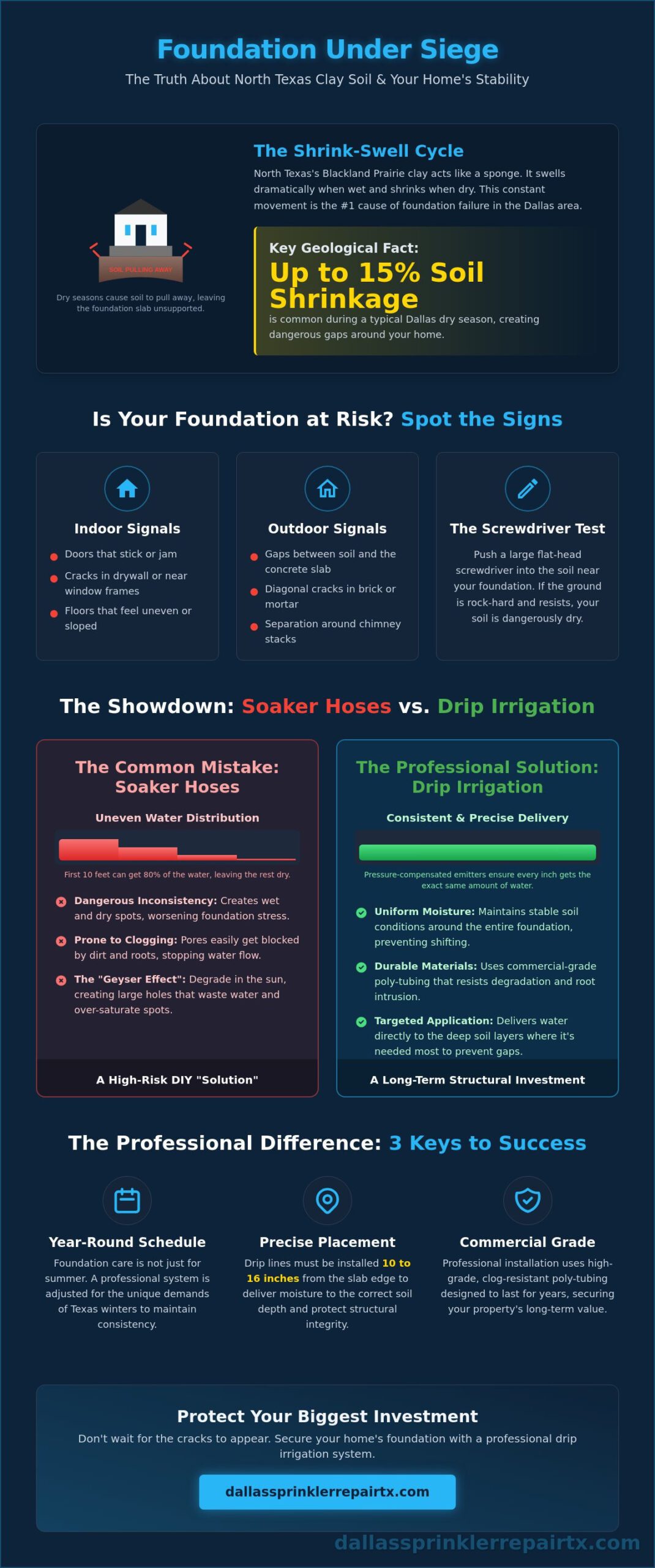
Some homeowners believe that foundation watering is a clever marketing tactic designed to sell unnecessary services. In reality, North Texas sits on some of the most volatile earth in the country. This region is dominated by Blackland Prairie clay, a substance that acts like a geological sponge. When it rains, the clay swells with incredible force. When the heat of a Dallas summer arrives, that same soil can experience shrinkage of more than 15% according to regional geological data. This constant movement, known as the shrink-swell cycle, is the primary cause of structural shifting in local homes. Installing a drip irrigation system specifically for your slab is a structural necessity, not a landscaping luxury.
Understanding North Texas Blackland Prairie Clay
The mineral composition of Dallas soil is uniquely volatile due to high concentrations of smectite minerals. These minerals expand when they absorb water and contract as they dry out. This creates a phenomenon called “foundation heave” during wet seasons and settlement during droughts. Expansive soil is a clay-rich earth that undergoes significant volume changes in response to moisture levels, which directly compromises the stability of slab-on-grade foundations. Without consistent moisture, the soil pulls away, leaving the heavy concrete slab unsupported. Maintaining a stable moisture environment through drip irrigation for foundation care is the only way to counteract this natural process.
Visual and Physical Indicators of Foundation Stress
You don’t need to be an engineer to spot the early signs of soil failure. It’s vital to monitor your property for these specific warning signs:
- Indoor signals: Look for doors that suddenly stick, window frames that show hairline cracks in the corners, or floors that feel uneven.
- Outdoor signals: Check for a visible gap forming between the soil and the concrete slab. Diagonal cracks in your brick mortar or separation around chimney stacks are emergency indicators.
- The Screwdriver Test: Take a large flat-head screwdriver and attempt to push it into the soil near your foundation. If the tool meets immediate resistance or the ground is rock-hard, your soil is dangerously dry.
A professional drip irrigation for foundation installation ensures that moisture reaches the deep layers of the clay, preventing the catastrophic “gap” that leads to structural failure. If you notice the soil is already pulling away, don’t wait for the cracks to widen. A professional sprinkler system tune-up can help determine if your current watering setup is failing to protect your home’s perimeter.
Drip Irrigation vs. Soaker Hoses: Debunking the Good Enough Myth
Many homeowners believe a $20 soaker hose from a big-box store provides the same protection as professional drip irrigation for foundation care. It’s an understandable mistake. On the surface, both tools deliver water to the soil. However, the physics of how that water reaches your slab determines whether your home stays level or shifts. Standard soaker hoses are made from recycled rubber tires and are inherently flawed for long-term structural protection. While they might seem like a bargain, their inconsistency often creates more problems than they solve.
The Problem with Porous Soaker Hoses
Porous hoses rely on weeping through the entire surface of the rubber. This design creates a massive pressure drop along the line. Often, the first 10 feet of the hose receives 80% of the water while the end of the line remains almost dry. This uneven distribution is dangerous for a foundation because it leaves some sections of your slab supported while others continue to sink. These hoses are also prone to the “Geyser Effect.” As the rubber degrades in the North Texas sun, small cracks turn into large holes that waste hundreds of gallons of water. Burying these hoses to protect them only accelerates failure, as root intrusion quickly clogs the pores and stops water flow entirely.
The Precision of Professional Drip Line Installation
A professional drip irrigation system installation uses high-grade poly-tubing equipped with pressure-compensated emitters. These emitters are engineered to release an exact amount of water regardless of whether they are at the beginning or the end of the line. This ensures every inch of your foundation receives equal moisture. Most professional systems also include check valves. These components prevent soil and debris from being sucked back into the emitters when the water is turned off, which is a common cause of failure in DIY setups.
Longevity is the final factor. A rubber soaker hose typically lasts one or two seasons before it becomes brittle or clogged with hard water minerals. In contrast, commercial-grade poly-tubing is designed to last 10 years or more. If you’re tired of replacing hoses every spring, a sprinkler system tune-up can identify if your current perimeter watering is actually reaching the soil or just running down the street. Investing in a permanent solution protects your equity and eliminates the seasonal chore of wrestling with tangled rubber hoses.
Professional Installation vs. DIY: The Easy Weekend Project Myth
Many DIY kits suggest that installing foundation protection is a simple afternoon task. You might be tempted to just lay a line on top of your mulch and call it a day. However, this approach ignores the engineering required to actually reach the deep clay layers that support your home. Surface watering is inefficient because the North Texas sun evaporates moisture before it can penetrate the soil. A professional drip irrigation for foundation installation ensures that water is delivered exactly where it’s needed to prevent the 15% soil shrinkage common in Dallas droughts. Without proper depth and placement, you’re merely dampening the mulch while your slab continues to settle.
Trenching and Placement Standards
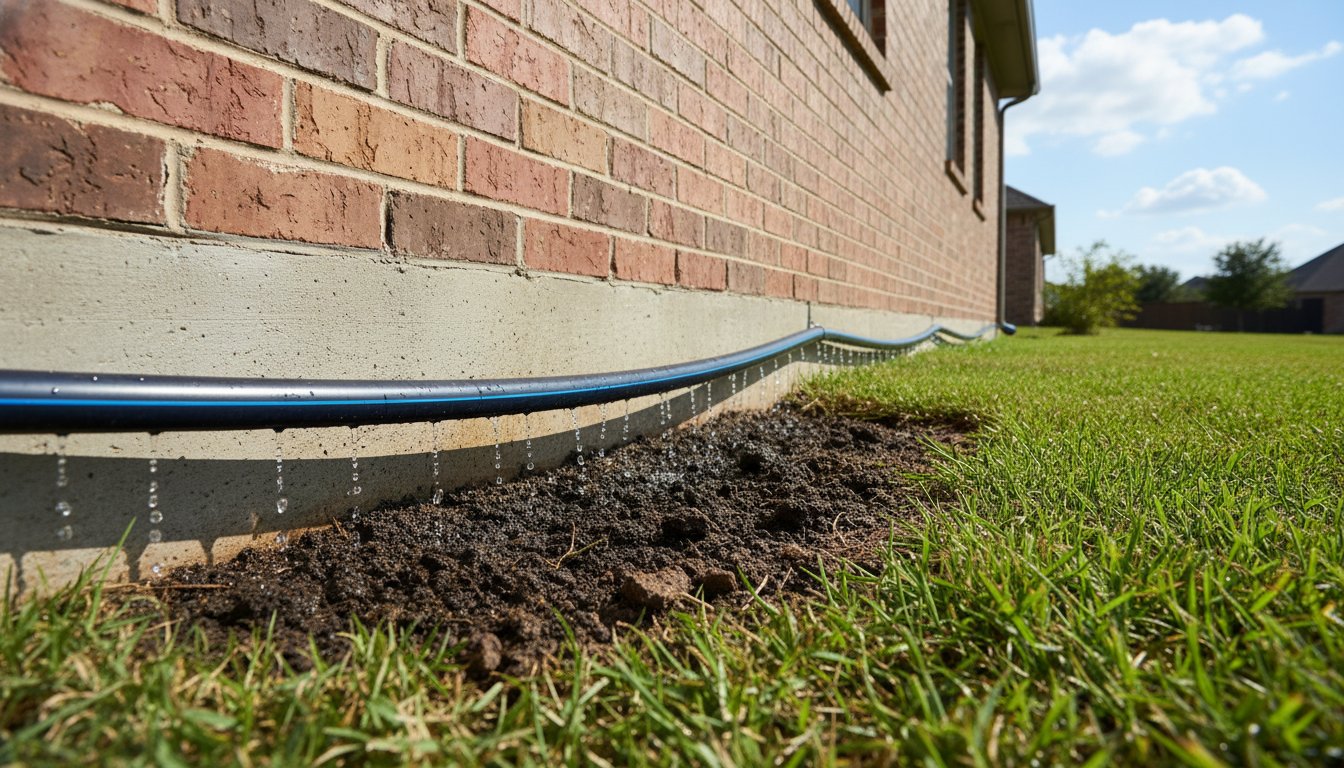
Proper placement is a science. While some generic guides offer conflicting advice, verified industry standards for the Dallas-Fort Worth region suggest placing drip lines between 10 and 16 inches away from the foundation edge. This specific distance allows water to bloom outward and downward, reaching the soil beneath the slab without causing hydrostatic pressure or pooling against the concrete. Professional installers bury these lines 2 to 4 inches deep. This subsurface placement protects the tubing from UV degradation, lawn mowers, and weed eaters. It also ensures that the water doesn’t just sit on the surface. We always recommend a dedicated irrigation zone for your foundation. Mixing foundation lines with flower bed zones often leads to overwatering plants or underwatering the slab, as their moisture requirements are vastly different.
Smart Controller Integration and Backflow Prevention
Modern protection goes beyond just pipes in the ground. Integrating your system with a smart controller allows for automated adjustments based on real-time Dallas weather station data. These systems can skip cycles when it rains and increase delivery during extreme heatwaves, ensuring your clay soil stays at a consistent volume year-round. It’s also a legal requirement in Texas to have a certified backflow prevention device installed. This prevents stagnant irrigation water from siphoning back into your home’s clean water supply. If your current setup lacks these safety features or you’re seeing signs of failure, a professional sprinkler repair Dallas specialist can audit your system to ensure it meets local codes and provides maximum protection for your property.
Maintenance and Scheduling: The Set It and Forget It Myth
Installing a high-quality system is a vital first step, but believing it requires zero oversight is a dangerous misconception. Even a professional drip irrigation for foundation setup needs seasonal calibration to account for the drastic shifts in North Texas weather. Soil conditions in July are vastly different from those in January. If you ignore your system for months at a time, you risk missing a line break or an emitter clog caused by hard water mineral buildup. Regular inspections ensure that your investment continues to provide the uniform moisture barrier your slab requires to remain stable.
Winter Foundation Watering in North Texas
Many homeowners make the mistake of turning off their irrigation entirely when the first cold front hits. However, dry winter winds in Dallas can sap moisture from the clay just as aggressively as the summer sun. When clay soil freezes while dry, it can lead to “frost heave,” causing further structural instability as the ground expands and contracts unevenly. To prevent this, maintain a reduced but consistent schedule. A typical North Texas home requires foundation watering approximately once every two weeks during the winter months if there is no significant rainfall. During a hard freeze, ensure your backflow preventer is insulated, but keep the soil moisture levels stable to prevent the clay from pulling away during the thaw.
Complying with Local Water Restrictions
Navigating municipal rules can be frustrating, but drip systems offer a significant advantage for property protection. As of spring 2026, cities like Richardson and Flower Mound have implemented mandatory two-day-a-week schedules for standard automatic sprinklers. Fortunately, most North Texas ordinances explicitly permit the use of a drip irrigation for foundation system at any time, even during daytime hours. This exemption exists because drip technology is incredibly efficient, delivering water directly to the soil with minimal evaporation loss. You can program your smart controller to run during off-peak hours to maintain deep soil saturation without violating local drought stages. If you’re concerned about water pooling or runoff during heavy rains, consider professional yard drainage solutions in Dallas to manage the moisture balance around your home. Schedule a sprinkler system tune-up today to ensure your controller is optimized for the current 2026 water conservation standards.
The Aquamax Solution: Precision Foundation Protection in DFW
Aquamax brings over 25 years of local experience to every project, navigating the specific challenges of North Texas clay with surgical precision. We understand that a mechanical fix is only as good as the materials used. That’s why we utilize high-grade, commercial poly-tubing for all drip irrigation for foundation installs. Unlike the porous rubber hoses that degrade in the sun, our tubing is built for longevity and consistent performance. Our licensed and insured technicians ensure every installation meets local building codes and rigorous safety standards. We take a “Full System” approach to property health; this means we don’t just add water, we balance irrigation with proper drainage to ensure your slab remains stable without becoming oversaturated.
Custom Design for Your Property
Every home in the Dallas-Fort Worth area has a unique footprint and varying levels of sun exposure. We don’t believe in a one-size-fits-all setup. Our experts calculate the specific Gallons Per Hour (GPH) required for your home’s perimeter based on soil density and the size of your slab. This data-driven approach ensures that the moisture barrier is deep and uniform. We can seamlessly integrate your foundation protection with a new or existing sprinkler installation, allowing you to manage your entire property from a single smart controller. This professionally engineered solution replaces the guesswork of manual watering with the calm confidence that your home’s structural integrity is handled by experts.
Get Started with a Foundation Health Check
The first step toward peace of mind is a comprehensive consultation. During an Aquamax foundation health check, we perform a thorough audit of your current watering methods. We often identify hidden leaks in existing sprinkler lines that might be undermining your slab or causing localized soil expansion. These “silent” issues can be just as damaging as a drought if left unaddressed. Our technicians provide a clear, functional plan to stabilize your soil through precision drip irrigation for foundation care. We handle the technical details, the trenching, and the controller programming so you don’t have to. Don’t wait for cracks to appear in your drywall before taking action. Protect your foundation today with a system designed for the North Texas environment.
Secure Your Dallas Home with Precision Foundation Care
Your home’s structural integrity depends on the stability of the soil beneath it. In North Texas, the volatile shrink-swell cycle of Blackland Prairie clay makes consistent moisture management a necessity rather than a luxury. We’ve seen how professional drip irrigation for foundation care outperforms temporary soaker hoses by delivering equal, deep-reaching moisture that prevents dangerous soil gaps. Relying on a “set it and forget it” approach or DIY kits often leads to inconsistent results and costly structural repairs down the road.
Aquamax has been serving the DFW area since 1998. Our licensed and insured technicians maintain an A+ rating for foundation protection systems by focusing on engineering and local expertise. We understand the specific environmental pressures of this region and provide the professional installation needed to safeguard your property through every season. Don’t leave your most valuable investment to chance or hardware store solutions. Protect Your Home with Professional Drip Installation and enjoy the peace of mind that comes with a stable, secure foundation. Your home deserves the highest standard of protection.
Frequently Asked Questions
How far should a drip line be from the foundation?
Place your drip lines approximately 10 to 16 inches away from the foundation edge. This specific distance allows the water to bloom outward and reach the soil beneath the slab without creating a pool of water directly against the concrete. Proper placement ensures the moisture reaches the deep clay layers where it’s most effective. If the line is too close, you risk water seeping into the crawlspace or basement areas.
Is a soaker hose or drip irrigation better for foundation care?
Professional drip irrigation is significantly better than a standard soaker hose for structural protection. Drip systems use pressure-compensated emitters to deliver an exact, uniform amount of water along the entire line. Soaker hoses often suffer from pressure drops and clogs, leading to uneven moisture that can cause one part of your home to sink while another stays stable. Additionally, commercial-grade poly-tubing lasts for a decade, whereas rubber hoses often fail after one season.
How long should I run my foundation drip system in the summer?
Most North Texas homes require 15 to 30 minutes of runtime per cycle during the peak of summer, depending on the emitter flow rate. The goal is to keep the soil moist enough that it doesn’t pull away from the concrete. Perform the “screwdriver test” regularly to ensure moisture is reaching a depth of at least 6 to 8 inches. If you notice a gap forming between the soil and the slab, increase the frequency of your watering cycles.
Do I need to water my foundation in the winter in Texas?
Yes, you must continue watering your foundation during the dry winter months. North Texas winters often bring low humidity and high winds that sap moisture from the clay soil just as effectively as the summer heat. A reduced schedule of once every two weeks is typically sufficient to prevent the soil from shrinking and shifting during the colder season. Maintaining consistent moisture year-round is the only way to prevent the damaging shrink-swell cycle of local clay.
Can foundation watering help with existing cracks in my walls?
A drip irrigation for foundation system stabilizes the soil to prevent existing cracks from widening or new ones from forming. It won’t “fix” structural damage that has already occurred, but it stops the cycle of movement that causes cracks to grow. If you see active shifting, stabilizing the moisture level is the first step before calling a repair specialist. Consistency is the key to preventing further damage to your drywall and brickwork.
Will a foundation drip system increase my water bill significantly?
A professionally installed drip system is highly efficient and rarely causes a significant spike in your water bill. Because it delivers water directly into the soil at a slow rate, there is virtually zero loss to evaporation or runoff. This method uses much less water than traditional spray heads while providing better protection for your home’s slab. It’s a cost-effective investment when compared to the five-figure bills associated with major foundation repairs.
Does a foundation drip line need its own zone on my sprinkler controller?
Yes, your foundation drip line should always be on its own dedicated zone. Shrubs and flowers have different moisture requirements than your concrete slab. By separating the drip irrigation for foundation zone, you can adjust the frequency and duration to keep the soil stable without overwatering your landscape plants or wasting water. This level of control is essential for managing the specific needs of expansive clay soil throughout changing seasons.
What happens if I overwater my foundation in North Texas?
Overwatering can lead to hydrostatic pressure and a phenomenon called “foundation heave,” where the soil expands too much and pushes the slab upward. You want the soil to be moist and pliable, not muddy or saturated. Avoid creating standing water or “swampy” conditions near your home, as this can lead to structural instability and potential mold issues. Balance is critical; the ground should feel like a wrung-out sponge rather than a puddle.