
Article by
Robert Maxvill
Owner of Aquamax Sprinkler Systems, American Sprinkler Repair and Dallas Drainage Systems.
You’ve spent hundreds on fresh pallets only to watch your backyard turn back into a muddy patch under the oak trees by mid-August. It’s a frustrating cycle many Dallas-Fort Worth homeowners know too well. Finding the best sod for shade in North Texas requires more than just reading a label at a big-box store. It’s about matching the right biology to our heavy Blackland Prairie clay and the intense heat of a Texas summer.
We understand that you want a lush, green lawn that doesn’t disappear the moment the canopy fills in. You’ll discover which shade-tolerant varieties actually thrive under North Texas oaks and how to maintain them under current 2026 water restrictions. We’ll break down the performance of Palmetto St. Augustine versus premium Zoysia options, providing a clear roadmap to a durable, beautiful landscape that lasts well beyond the first season. From soil preparation to professional installation, this guide ensures your investment in a shady lawn finally takes root.
Key Takeaways
- Identify why Bermuda grass fails in low light and which shade-tolerant varieties like Palmetto St. Augustine or Zeon Zoysia are built for North Texas landscapes.
- Discover how to choose the best sod for shade in North Texas by evaluating your lawn’s specific sunlight exposure and soil drainage needs.
- Learn to navigate 2026 mandatory watering schedules while keeping thirstier shade varieties healthy in heavy Blackland Prairie clay.
- Master the soil preparation process, from removing dead thatch to tilling in organic compost, to prevent common installation failures.
- Understand the advantage of professional installation that synchronizes your irrigation system with the specific water needs of your new sod.
The Shade Challenge: Why Bermuda Grass Fails in North Texas
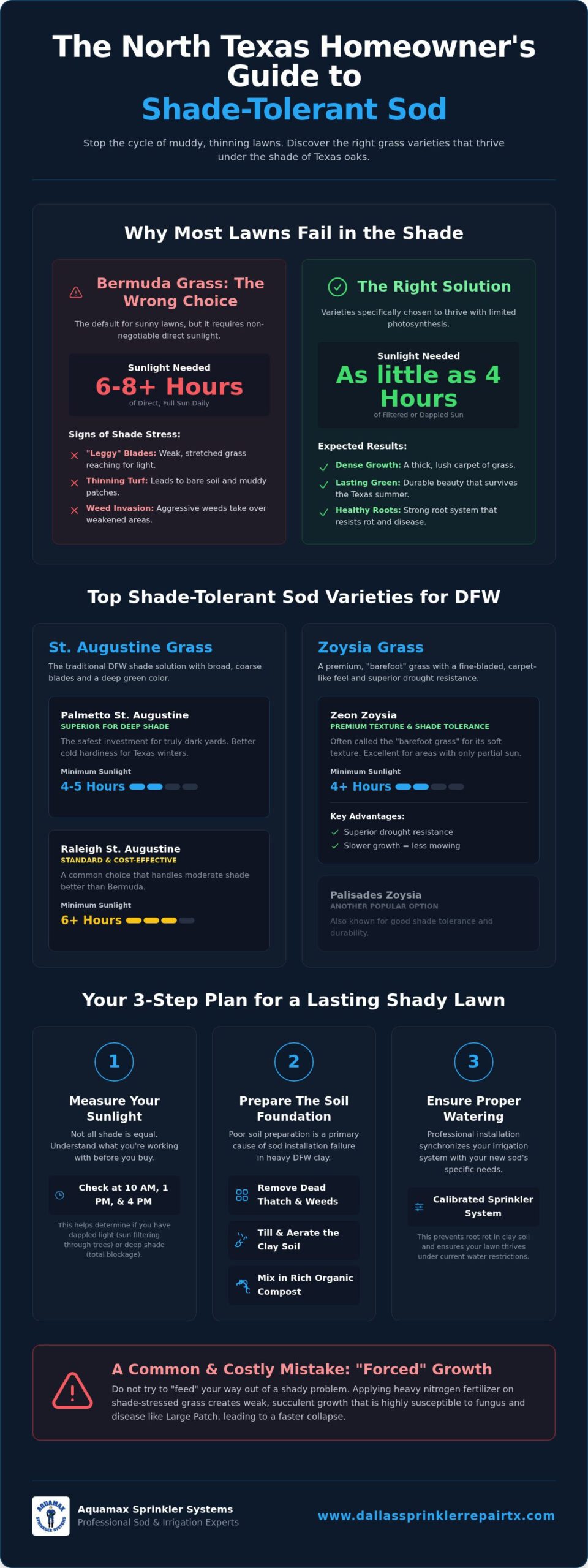
Most North Texas lawns start with Bermuda grass by default. It’s a rugged, heat-resistant choice for open fields, but it has a non-negotiable requirement: direct sunlight. Bermuda grass needs a minimum of six to eight hours of full sun to maintain its density and health. When your property features mature Live Oaks, Cedar Elms, or tall fences, that sunlight disappears. Without enough light, Bermuda grass enters a state of permanent decline that no amount of water or fertilizer can fix.
You’ll notice the signs of shade stress long before the grass actually dies. The blades become “leggy” as they stretch upward, trying to reach more light. This stretching weakens the plant’s structure. Eventually, the turf thins out, leaving bare soil that invites aggressive weeds and creates muddy patches. Understanding what sod is helps explain this failure. It’s a living system of interconnected plants that rely on photosynthesis to survive. When light is blocked, the plant’s energy production stops, and the root system begins to shrink.
In the DFW Blackland Prairie, our heavy clay soil compounds these issues. Shaded areas don’t evaporate moisture as quickly as sunny spots. This trapped water around weakened roots often leads to rot or fungal infections. This environmental combination makes finding the best sod for shade in North Texas a necessity for any homeowner with a canopy of trees. Choosing the right variety through professional sod installation is the only way to break the cycle of seasonal lawn failure.
Understanding Sunlight Requirements
Not all shade is created equal in a Dallas backyard. Dappled shade occurs when sunlight filters through a loose tree canopy, while deep shade is the total blockage of light by a building or a dense evergreen. To measure your lawn’s light, you should track the sun’s path at three different times: 10 a.m., 1 p.m., and 4 p.m. Southern turfgrass relies on photosynthesis to survive our winter dormancy. If the grass doesn’t “charge up” its energy reserves during the summer, it won’t have the strength to wake up in the spring.
The Dangers of ‘Forced’ Growth
Many homeowners try to “feed” their way out of a shady problem by applying heavy nitrogen fertilizer. This is a dangerous mistake. In the shade, high nitrogen levels create weak, succulent growth that is highly susceptible to Large Patch and other fungi. Large trees also act as massive straws, out-competing your grass for every drop of water and nutrient in the soil. There is no such thing as a “no-sun” grass variety in Texas. Every option requires at least some level of light to survive, and forcing growth only speeds up the lawn’s eventual collapse.
Top Shade-Tolerant Sod Varieties for Dallas-Fort Worth
Choosing the best sod for shade in North Texas requires a balance between light requirements and heat endurance. While Bermuda grass dominates the sunny plains of DFW, homeowners with mature tree canopies must look toward species that can survive on limited photosynthesis. St. Augustine and Zoysia are the two primary contenders for these environments. Each offers a distinct aesthetic and maintenance profile, but both require a precise irrigation setup to survive the transition into our heavy clay soils.
St. Augustine remains the traditional choice for North Texas shade. It features a broad, coarse blade and a vibrant deep-green color. However, its success depends heavily on managing lawn grasses in shade through proper mowing heights and watering schedules. Zoysia has gained massive popularity recently as a premium alternative. It provides a carpet-like feel and superior drought resistance, making it ideal for those who want a luxury look without the high water demands of traditional varieties.
St. Augustine Varieties: Palmetto vs. Raleigh
Palmetto St. Augustine is widely considered the superior choice for shaded DFW backyards. It demonstrates better cold hardiness than other cultivars, which is vital during our occasional deep freezes. It can thrive with as little as four to five hours of sunlight. Raleigh St. Augustine is the region’s standard variety because it’s widely available and cost-effective. While it handles shade better than Bermuda, it typically requires at least six hours of sun to remain dense. If your yard is truly dark, Palmetto is the safer investment for long-term survival.
Zoysia Varieties: Zeon and Palisades
Zeon Zoysia is often called the “barefoot grass” because of its soft, fine-bladed texture. It’s remarkably shade-tolerant, often thriving in areas that receive only four hours of direct light. It’s a slow grower, which means you’ll spend less time mowing, though it takes longer to recover from heavy damage. Palisades Zoysia features a slightly wider blade and is much better suited for high-traffic areas. If you have kids or dogs playing under your trees, Palisades offers the durability you need without sacrificing shade performance.
You might see Fescue advertised as a shade solution, but be cautious. Fescue is a cool-season grass that looks beautiful in March but often melts away when August temperatures hit 100 degrees. In North Texas, Fescue is usually a temporary fix that requires yearly over-seeding. For a permanent, sustainable lawn, sticking with a high-quality warm-season sod is the professional recommendation. If you aren’t sure which variety fits your specific canopy density, our team at Aquamax can help you select and perform a professional sod installation tailored to your property’s microclimate.
Comparing Maintenance: Water, Traffic, and Durability
Maintaining a shady lawn in DFW requires a different strategy than managing a sun-drenched Bermuda field. Even when you select the best sod for shade in North Texas, your long-term success depends on how you balance water, traffic, and mowing heights. St. Augustine is notoriously thirsty and requires consistent moisture to maintain its broad, lush blades. In contrast, Zoysia varieties are significantly more water-efficient. However, because shaded soil retains moisture longer than sunny areas, overwatering is a common pitfall that leads to devastating fungal outbreaks.
Fungal diseases like Large Patch and Gray Leaf Spot thrive in the humid North Texas spring. Shaded St. Augustine is particularly vulnerable when the soil stays damp for too long. Consulting a research-based St. Augustinegrass Lawn Management guide can help you identify these risks before they kill your turf. You should also adjust your mower settings. Shaded grass needs to be kept about 0.5 to 1 inch taller than grass in full sun. This extra blade length provides more surface area for photosynthesis, which is critical when light is scarce.
The Irrigation Connection
Shaded zones typically require 30% to 50% less water than sunny areas. If you run all irrigation zones on the same schedule, you’ll likely drown your shade-tolerant sod and invite root rot. Precision is mandatory. We recommend a professional sprinkler system tune-up to ensure your heads are delivering the exact amount of water needed for these specific micro-climates. Smart controllers are also highly effective tools. They allow you to adjust individual zones based on shade levels and current weather data, helping you stay compliant with 2026 mandatory watering restrictions.
Long-Term Durability
Durability involves more than just foot traffic. North Texas homeowners must consider recovery speed after extreme weather events, such as the major freezes seen in recent years. While Zoysia is generally more resilient to cold, Palmetto St. Augustine is the most cold-hardy of its species. Weed management is another factor. Shaded areas often have thinner turf, making them easy targets for winter weeds. If your shaded area stays consistently soggy after rain, it may be time to look into yard drainage solutions. Proper drainage prevents the stagnant water that kills even the most shade-tolerant varieties.
Preparing Your Soil for Successful Sod Installation
Even the best sod for shade in North Texas will fail if it’s laid on top of compacted, nutrient-depleted clay. Successful installation starts long before the first pallet arrives on your driveway. In the DFW area, our “Blackland Prairie” soil is notorious for its high clay content, which shrinks when dry and swells when wet. This movement, combined with the lack of sunlight under large trees, creates a hostile environment for new roots. You must transform this heavy base into a receptive environment to ensure your investment takes hold.
Step 1 requires the total removal of existing weeds and dead Bermuda thatch. Simply laying new grass over old, dying turf creates a barrier that prevents root-to-soil contact. Use a sod cutter to clear the area completely. Step 2 involves tilling the ground to a depth of four to six inches. During this stage, you should incorporate organic compost to improve soil structure. Grading the surface is Step 3. You must ensure the ground is level but slightly sloped to prevent “soggy” spots where water might pool. Finally, Step 4 is the critical “first soak.” Within 30 minutes of installation, the sod must be watered deeply to eliminate air pockets and begin the bonding process.
Soil Amending for North Texas Clay
Relying on “black dirt” or generic topsoil is a common mistake. These materials often sit on top of the clay without integrating, leading to shallow root systems. To truly improve the best sod for shade in North Texas, you should use expanded shale or high-quality organic compost to break up the clay’s density. Testing your soil pH is also essential; shaded areas often have different acidity levels than sunny spots, which can block nutrient uptake. Mechanical core aeration allows oxygen to reach the root zone, preventing the stagnant conditions that cause root rot in shaded St. Augustine.
Grading and Drainage
Mature shade trees present a unique challenge because their large root flares often disrupt the natural flow of water. These flares create high spots and hidden basins where water collects, drowning the new sod. You must carefully grade the area so water moves away from your home’s foundation while still keeping the sod moist enough to thrive. If your yard has a heavy canopy cover that prevents natural evaporation, you may need to install professional drainage systems to handle runoff. Proper site preparation is the difference between a lawn that thrives for a decade and one that dies in a year. For a guaranteed result, contact Aquamax for professional sod installation that includes expert soil preparation and grading.
Professional Sod Installation with Aquamax Sprinkler Systems
Most landscaping companies treat sod like a commodity. They drop the pallets, roll out the grass, and leave before the first irrigation cycle begins. At Aquamax, we take a different approach. We’ve spent over 25 years serving the Dallas-Fort Worth area, and we understand that finding the best sod for shade in North Texas is only half the battle. The real challenge is ensuring that your new turf survives the critical first 30 days in our unique climate. Our dual expertise in both high-end irrigation systems and professional landscaping ensures your investment is protected from the moment it touches the soil.
Our process is methodical and purposeful. We start with the rigorous soil preparation mentioned earlier, but we don’t stop there. We only use fresh-cut, local Texas sod that is harvested specifically for your project. This reduces transplant shock and ensures the grass is already acclimated to our regional environment. Once the installation is complete, our technicians perform a final irrigation calibration. We adjust your sprinkler heads and controllers to deliver the precise saturation levels required for your specific variety, whether you’ve chosen Palmetto St. Augustine or Zeon Zoysia. We currently provide these comprehensive services to homeowners across Plano, Frisco, McKinney, and the entire DFW metroplex.
Why Choose Aquamax for Your New Lawn?
Experience matters when you’re dealing with the difficult “Blackland Prairie” clay of North Texas. Since 1998, we’ve helped thousands of property owners transform muddy, shaded patches into vibrant landscapes. Our team consists of licensed technicians who understand the local ecosystem and the specific water requirements of shade-tolerant turf. We prioritize reliability and long-term vitality over quick, cheap fixes. You can read our customer reviews to see how our methodical approach has delivered lasting results for your neighbors.
Next Steps for a Lush Shady Lawn
Don’t wait until your backyard is a complete loss to take action. If your current grass is thinning or weeds are taking over your shaded zones, it’s time for a professional evaluation. We’ll assess your canopy density, soil health, and current irrigation efficiency to determine the best path forward. Combining your sod installation with a comprehensive system check-up is the most effective way to guarantee a lush, green result. Contact us today to schedule a site evaluation and receive a professional estimate for your property.
Achieve a Thriving Shady Landscape This Season
Maintaining a beautiful lawn under a mature canopy requires a strategic shift in how you view your landscape. You’ve learned that Bermuda grass simply cannot survive DFW shade and that success depends on selecting premium varieties like Palmetto St. Augustine or Zeon Zoysia. These choices, combined with rigorous soil preparation and tailored drainage, provide the foundation for a permanent green space that won’t disappear when the summer heat intensifies.
As licensed and insured DFW specialists since 1998, Aquamax Sprinkler Systems understands the intersection of turf biology and irrigation technology. We ensure your best sod for shade in North Texas is supported by a perfectly calibrated water delivery system. Whether you need a full installation or custom drainage solutions to protect your property, our team delivers the local expertise your lawn deserves. We handle the technical details of soil amendment and irrigation timing so you can simply enjoy your outdoor space.
Get a Professional Sod Installation Estimate from Aquamax Sprinkler Systems
Stop fighting against the shade and start working with it. We’re ready to help you build a durable, vibrant lawn that stands up to the Texas summer and provides lasting peace of mind.
Frequently Asked Questions
What is the most shade-tolerant grass for North Texas?
Palmetto St. Augustine is widely recognized as the most shade-tolerant warm-season grass for our region. It maintains its density with significantly less light than Bermuda. Zeon Zoysia is a premium second choice, offering a finer texture and better drought resistance. Both are excellent candidates when you are looking for the best sod for shade in North Texas.
Can St. Augustine grass grow in total shade?
No grass variety can survive in 100% total shade. All turfgrass requires photosynthesis to produce energy and maintain root health. Even the most tolerant varieties need at least four hours of filtered or direct sunlight daily. If an area receives zero sun, you should consider hardscaping or shade-loving groundcovers instead of traditional sod.
Is Zoysia grass better than St. Augustine for North Texas shade?
Zoysia is often considered a premium choice due to its soft feel and lower water requirements once established. St. Augustine is the traditional king of shade because it handles the humidity of North Texas springs well and fills in quickly. The right choice depends on your budget, foot traffic levels, and how much you want to spend on monthly water bills.
How many hours of sun does Zeon Zoysia need?
Zeon Zoysia requires a minimum of four hours of direct sunlight to stay healthy. While it’s remarkably resilient, providing five to six hours will result in a much denser, more vibrant carpet. If your trees create a solid block of shade for the entire day, you may need to thin the canopy to ensure the grass receives enough light.
Why does my grass keep dying under my oak trees?
Oak trees are aggressive competitors that steal water and nutrients from the soil before the grass can reach them. Additionally, the dense canopy blocks essential sunlight, while falling leaves can smother the turf if not cleared. Surface roots also cause soil compaction, making it difficult for grass roots to penetrate the heavy North Texas clay.
When is the best time to install shade-tolerant sod in Dallas?
The ideal window for installation in Dallas is during the spring, specifically late March to May, or early fall in September and October. These periods offer moderate temperatures that allow roots to establish without the stress of 100 degree summer heat. Installing during these windows ensures your new lawn is strong enough to handle the upcoming dormant season.
How much does professional sod installation cost in DFW?
Professional installation costs vary based on the grass variety selected, the total square footage, and the amount of soil preparation required. Factors such as old turf removal, tilling, and adding organic compost will influence the final estimate. We recommend a site evaluation to provide an accurate quote tailored to the specific drainage needs and challenges of your property.
Do I need to change my sprinkler settings for shaded grass?
Yes, you must adjust your irrigation zones for shaded areas. Shaded grass doesn’t lose moisture as quickly as sun-exposed turf, so it typically requires 30% to 50% less water. Overwatering shaded sod is a leading cause of root rot and fungal disease. A professional tune-up ensures each zone delivers the correct amount of water for its specific micro-climate.