
Article by
Robert Maxvill
Owner of Aquamax Sprinkler Systems, American Sprinkler Repair and Dallas Drainage Systems.
In North Texas, planting your new lawn just two weeks too late can be the difference between a vibrant, resilient turf and a scorched, brown investment. Most homeowners assume spring is the universal season for greenery, but the reality of our climate is far more demanding. To achieve a lawn that survives July’s triple-digit heat, you have to work within a narrow window dictated by soil temperature and local weather patterns. Understanding the best time to plant grass is your first line of defense against the common frustration of watching new growth die immediately after installation.
We know it’s exhausting to deal with thinning patches or skyrocketing water bills caused by improper establishment. You want a thick, green lawn that adds value to your property without wasting resources. This guide provides the precise timing you need to ensure your grass takes root quickly and stays healthy for years. We’ll examine the specific months for warm-season varieties, explain how to manage Dallas’s twice-weekly watering restrictions, and help you choose between seed and sod for the most efficient results. By the end of this article, you’ll have a clear roadmap for a lush, heat-resistant landscape that thrives in our unique environment.
Key Takeaways
- Identify the April through June window as the best time to plant grass to ensure roots establish before the intense July heat.
- Navigate the North Texas transition zone by timing warm-season growth peaks and using winter overseeding for year-round vitality.
- Audit your irrigation system for 100% head-to-head coverage to prevent new sod from failing during the establishment phase.
- Understand why professional sod installation outperforms DIY seeding in the challenging, heavy clay soils of Dallas and Fort Worth.
- Learn to balance the risks of the “May Monsoon” rains against the summer drought to protect your landscaping investment.
Understanding the North Texas Planting Calendar
Dallas and the surrounding Fort Worth area occupy a unique ecological region known as the “Transition Zone.” In this climate, neither cool-season nor warm-season grasses are perfectly adapted to thrive year-round without precise intervention. This means the best time to plant grass isn’t just about picking a sunny weekend; it’s about matching the biological needs of the turf to our volatile local weather patterns. Our region experiences extreme shifts between searing summer heat and sudden winter freezes, leaving a very narrow margin for successful establishment.
Planting outside these specific windows leads to immediate root failure. The intense North Texas sun can scorch unestablished seedlings in days. Early autumn freezes can kill off young sod before it anchors. Current 2026 weather trends show increasingly erratic “false springs,” where warm weeks are followed by sudden frost. This makes professional timing essential to protect your landscape investment and ensure your lawn has the strength to survive its first year.
To better understand how these seasons impact your lawn, watch this helpful video:
Warm-Season vs. Cool-Season Grasses in DFW
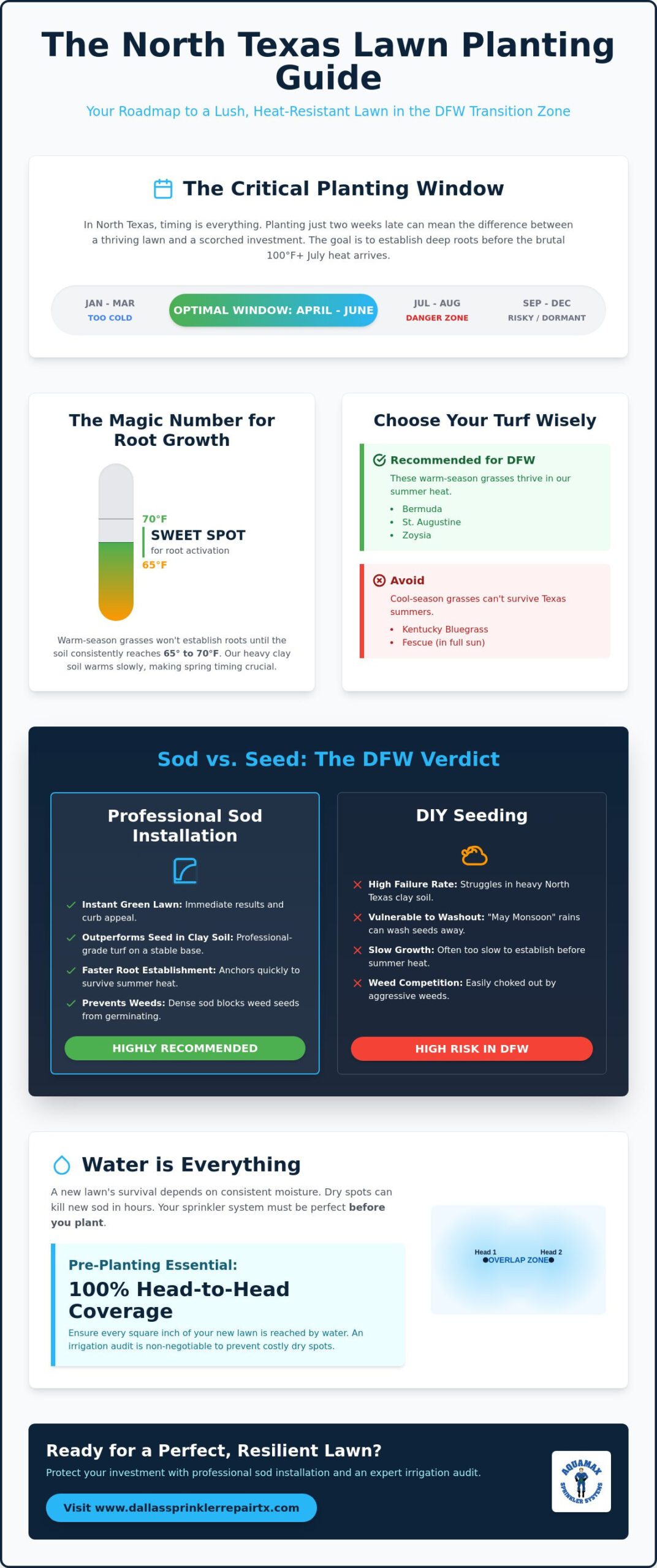
Most Dallas lawns feature warm-season species like Bermuda, Zoysia, or St. Augustine grass. These varieties peak during the hottest months and go dormant in winter. Choosing the wrong species, such as Kentucky Bluegrass, often results in a lawn that cannot survive our triple-digit summers. For those who desire year-round green, we often recommend temporary winter overseeding with Perennial Ryegrass. This provides a lush look while your permanent turf is dormant without competing with its spring recovery.
The Role of Soil Temperature
Air temperature is a secondary concern compared to soil temperature. For warm-season grasses to establish, the soil must consistently reach a threshold of 65 to 70 degrees. Our heavy North Texas clay is excellent at retaining heat, but it also takes longer to warm up in the spring than sandy soils found elsewhere. You can use a simple soil probe or check local agricultural extensions for real-time 2026 data before scheduling your sod installation. Planting too early into cold, damp clay leads to rot rather than growth. Proper timing ensures the roots wake up and begin anchoring immediately.
The Ideal Window for Warm-Season Grasses (Spring & Early Summer)
The best time to plant grass in North Texas is between April and June. This period is the “Goldilocks” zone for Dallas homeowners. It provides soil temperatures warm enough for rapid root activity while preceding the brutal, sustained heat of late summer. You must balance the heavy rainfall of the “May Monsoon” against the looming July drought. If you delay planting until August, the inevitable 100-degree days will likely kill your new turf before it can establish a deep, resilient root system.
Establishing these roots before the peak of summer is non-negotiable for long-term lawn health. Bermuda grass is particularly aggressive and can often anchor within two weeks if the soil is warm and moist. St. Augustine takes longer to establish and is more sensitive to drying out during the process. If you’re concerned about your yard’s ability to support new growth, consider a professional sod installation to give your property an immediate, healthy foundation.
April to May: The Prime Planting Peak
Early spring is the most reliable window for establishing a new lawn. Planting during these months allows you to leverage natural North Texas rainfall, which reduces your initial irrigation costs and helps settle the soil around new roots. However, you must remain vigilant against late-March frosts that can damage tender new shoots. According to the Turfgrass Selection for Texas guide, selecting the right species for your specific light levels is just as important as the timing itself. Proper early-season planting avoids the high evaporation rates seen in later months, ensuring more water reaches the root zone.
Late June: The Last Chance for Summer Survival
By late June, the Texas heat dome often begins to settle over the Dallas-Fort Worth metroplex. Planting during this time is risky but achievable with rigorous preparation. Your primary focus must be moisture consistency. Before laying any new turf in June, it’s essential to perform a sprinkler system tune-up to ensure every square inch of the yard receives uniform, head-to-head coverage. Without a perfectly functional irrigation system, the heavy clay soil will bake and crack. This causes the sod to shrink and leaves gaps that invite weeds to take over. Successful late-season planting requires a proactive approach to water management to combat the rising temperatures.
Fall Planting and Winter Overseeding Strategies
While spring is the primary window for warm-season varieties, September is arguably the best time to plant grass if you want to avoid the high-stress establishment phase of mid-summer. September provides a vital reprieve. As overnight temperatures begin to drop while the soil remains warm from the summer sun, roots can establish without the immediate threat of dehydration. This is the secondary window for professional sod installation, allowing Bermuda and St. Augustine to anchor before they enter winter dormancy in December.
For homeowners managing shaded properties, the rules change. Fescue is the only viable option for deep shade in Dallas, and it requires the cooler temperatures of autumn to germinate. You’ll find extensive guidance on managing these specific varieties in various AggieTurf publications. Planting Fescue in the fall gives it two full seasons of temperate weather to mature before it faces its biggest challenge: the North Texas summer. For homeowners managing shaded properties or looking to repair heat-damaged turf, autumn is often the best time to plant grass in North Texas.
The September Recovery Window
Use the cooler nights of September to focus on root establishment. This month is ideal for repairing summer heat damage with targeted reseeding or patching. The goal is to maximize root depth before the first North Texas freeze, which typically arrives in mid-to-late November. You aren’t looking for lush top growth right now. You’re building a foundation. If the roots don’t anchor deep into the clay before the ground chills, the turf won’t survive the dry winter winds. Monitor your irrigation closely; even though it’s cooler, new patches still need consistent moisture to prevent the clay from cracking.
Overseeding for Winter Color
If you want a “Winter Green” lawn, time your Ryegrass application for late October. This is when your primary Bermuda or St. Augustine lawn begins to “sleep” or turn brown. Don’t apply Ryegrass too early, or it will compete with your permanent grass for nutrients. Once established, Ryegrass needs significantly less water than summer turf. Be careful with your winter watering schedule. Dormant warm-season roots are prone to fungal issues if the soil stays saturated in December. As spring approaches, you’ll need to transition back to your primary grass by mowing the Ryegrass short, allowing sunlight to reach the waking Bermuda or St. Augustine below.
Preparing Your Irrigation System for New Grass
Choosing the best time to plant grass is only half the battle. If your irrigation system isn’t prepared to handle the demands of a new lawn, your investment will fail. A malfunctioning sprinkler system is the leading cause of death for new turf in North Texas. Our heavy clay soil and intense sun leave no room for error. A single skipped zone or a broken head can result in scorched patches that never recover.
Before you lay a single piece of sod, you must ensure 100% head-to-head coverage. This means the water from one sprinkler head must reach the base of the neighboring head. Gaps in coverage create dry spots that are nearly impossible to fix once the roots have begun to struggle. If you notice uneven spray patterns or low pressure, it’s vital to prioritize an irrigation repair to stabilize your system before the planting date arrives.
Navigating Dallas water restrictions is also critical for legal compliance in 2026. While the city typically enforces a twice-weekly watering schedule, there’s a temporary exception for newly installed lawns. Most properties are granted a 30-day variance to allow for frequent establishment watering. You may need to register your new lawn with the city to qualify. Failing to do so could result in fines ranging from $250 to $2,000 per violation. Ensure your system’s rain and freeze sensors are fully operational, as these are required by local regulations to prevent water waste during spring storms.
The Pre-Planting Irrigation Audit
A thorough audit involves more than just turning on the controller. Inspect every zone for clogged nozzles, broken risers, and heads that have sunk too deep into the soil. These mechanical issues prevent water from reaching the surface of the new sod. Test your rain sensor to ensure it’s communicating with the controller. This prevents the system from running during a heavy downpour, which can lead to fungal diseases in young grass. A proactive audit ensures that when the best time to plant grass arrives, your property is ready to support it.
Smart Watering for New Lawns
New grass requires a “little and often” watering approach during the first 14 days to keep the root zone consistently moist. You should program your controller to run multiple short cycles throughout the day rather than one long soak. For areas adjacent to your home’s foundation, consider using drip irrigation to maintain moisture levels without creating runoff. As the grass takes root, gradually transition to a “cycle-and-soak” method. This encourages roots to grow deeper into the clay soil, making the lawn more drought-tolerant. If you aren’t confident in your controller’s programming, contact our team for a professional system setup to guarantee your new lawn’s success.
Why Professional Sod Installation Beats DIY Seeding in Dallas
Professional installation offers a level of stability that seed simply can’t match. When you lay sod, you’re bypassing the most vulnerable stage of lawn growth. This is vital in North Texas, where the transition from spring to scorching summer happens in the blink of an eye. If your seedlings haven’t matured by the first 90-degree day, they’ll likely perish. Sod provides the density needed to crowd out weeds and the resilience to handle the foot traffic that would destroy a germinating lawn. It’s the most reliable way to ensure your landscape remains vibrant through the peak of summer.
Site Prep: The Foundation of a Green Lawn
A successful lawn starts several inches below the surface. Professional site preparation involves more than just clearing the area. We focus on tilling the compacted clay and integrating soil amendments to improve aeration and nutrient delivery. Proper grading is the most critical step. Without it, you’ll face standing water and root rot. Our team ensures the ground slopes away from your home, preventing future drainage issues that could threaten your foundation. We remove all existing weeds and old turf properly, creating a clean slate for your new sod to thrive and expand.
The Aquamax Advantage in DFW
At Aquamax, we don’t just lay grass; we build sustainable landscapes. Our specialized approach to sod installation in Dallas integrates your new turf with custom irrigation and drainage solutions. This comprehensive strategy ensures your lawn receives the exact amount of water it needs without the risk of oversaturation. By combining professional installation with a perfectly tuned sprinkler system, we provide a “set it and forget it” experience for homeowners. Even if you schedule your project during the best time to plant grass, the quality of the installation determines the final result. Contact Aquamax for a professional lawn evaluation to start your project today.
Secure Your North Texas Lawn for the Seasons Ahead
Success in the Dallas-Fort Worth transition zone requires more than just high-quality turf. It demands a strategic alignment between soil temperatures and professional irrigation management. You’ve learned that the best time to plant grass is a narrow window where root establishment must outpace the impending Texas heat or winter dormancy. By prioritizing a thorough irrigation audit and choosing sod over seed, you eliminate the risks associated with our heavy clay soil and erratic weather patterns.
Just as you invest in the resilience of your lawn, investing in your own health is vital for staying active and recovering from outdoor projects; click here to see how PureONE molecular hydrogen supports your wellness.
Aquamax has been serving the DFW metroplex since 1998 as licensed and insured irrigation specialists. We provide custom drainage and sod solutions designed to protect your home’s foundation and ensure long-term vitality. Don’t leave your property’s aesthetic to chance or improper timing. Schedule Your Professional Sod Installation & Irrigation Audit Today to ensure your lawn receives the expert care it deserves. We’re ready to help you build a thriving, resilient landscape that lasts for years to come.
Frequently Asked Questions
Can I plant grass in July in North Texas?
Planting grass in July is highly discouraged in North Texas because extreme heat and high evaporation rates create a hostile environment for new growth. While possible with intensive irrigation, the risk of root failure is significant as temperatures frequently exceed 100 degrees. Most homeowners find that the best time to plant grass is earlier in the spring to avoid these brutal conditions. If you must plant in July, you’ll need a perfectly tuned sprinkler system and a variance from local water restrictions.
What is the easiest grass to grow in the Dallas area?
Bermuda grass is considered the easiest variety to grow in the Dallas area because of its high drought tolerance and rapid recovery rate. It thrives in full sun and handles the heavy clay soil of North Texas better than most species. While St. Augustine is popular for shaded yards, Bermuda’s aggressive growth pattern allows it to fill in bare spots quickly. This makes it a dependable, low-maintenance choice for many local residential properties.
How much should I water new sod in the Texas heat?
New sod requires frequent, short watering cycles to keep the root zone consistently moist without causing runoff. In the peak Texas heat, you should water three to four times daily for the first 14 days. Limit each cycle to five or ten minutes to prevent the clay soil from becoming oversaturated. This “little and often” approach ensures the sod doesn’t shrink or pull apart as it establishes its new root system.
Do I need to till my Dallas clay soil before planting grass seed?
You must till Dallas clay soil before planting grass seed to prevent the ground from acting like a concrete barrier. Tilling to a depth of four to six inches allows the tiny seeds to make direct contact with the soil and access necessary nutrients. Without this preparation, seeds often wash away during spring storms or fail to penetrate the compacted surface. Adding organic compost during the tilling process further improves the overall soil structure.
Will new grass survive a late spring freeze in DFW?
Established sod typically survives a late spring freeze in DFW, but tender young seedlings from recent seeding are at high risk. If a frost is forecasted, water your new lawn thoroughly the evening before the temperature drops. Moist soil retains heat better than dry soil, which helps protect the root system from freezing. For new sod, the thermal mass of the turf itself provides an extra layer of insulation against sudden temperature shifts.
How long does it take for new sod to take root in North Texas?
New sod generally takes 10 to 14 days to begin taking root in North Texas under ideal conditions. You can check the progress by gently lifting a corner of a sod piece; if you feel resistance, the roots have started to anchor into the clay. Full establishment, where the lawn can handle regular foot traffic and a standard watering schedule, usually takes about 30 days of consistent care.
Is fall or spring better for lawn repair in Plano and Frisco?
Spring is the superior choice for repairing Bermuda or St. Augustine lawns in Plano and Frisco as these grasses enter their peak growth phase. However, if you’re repairing a shaded area with Fescue, fall is the best time to plant grass to take advantage of cooler soil temperatures. Matching your repair schedule to the specific grass species ensures the new patches blend seamlessly with the rest of your existing landscape.
Can I use a smart sprinkler controller to manage new grass watering?
Smart sprinkler controllers are excellent tools for managing new grass because they allow for precise, multi-cycle programming directly from your phone. You can easily set up an establishment schedule that meets the frequent watering needs of new sod while staying compliant with local rain-sensing requirements. Many modern controllers also adjust based on real-time weather data, preventing water waste during the rainy spring months common in the Dallas-Fort Worth metroplex.