


Article by
Robert Maxvill
Owner of Aquamax Sprinkler Systems, American Sprinkler Repair and Dallas Drainage Systems.
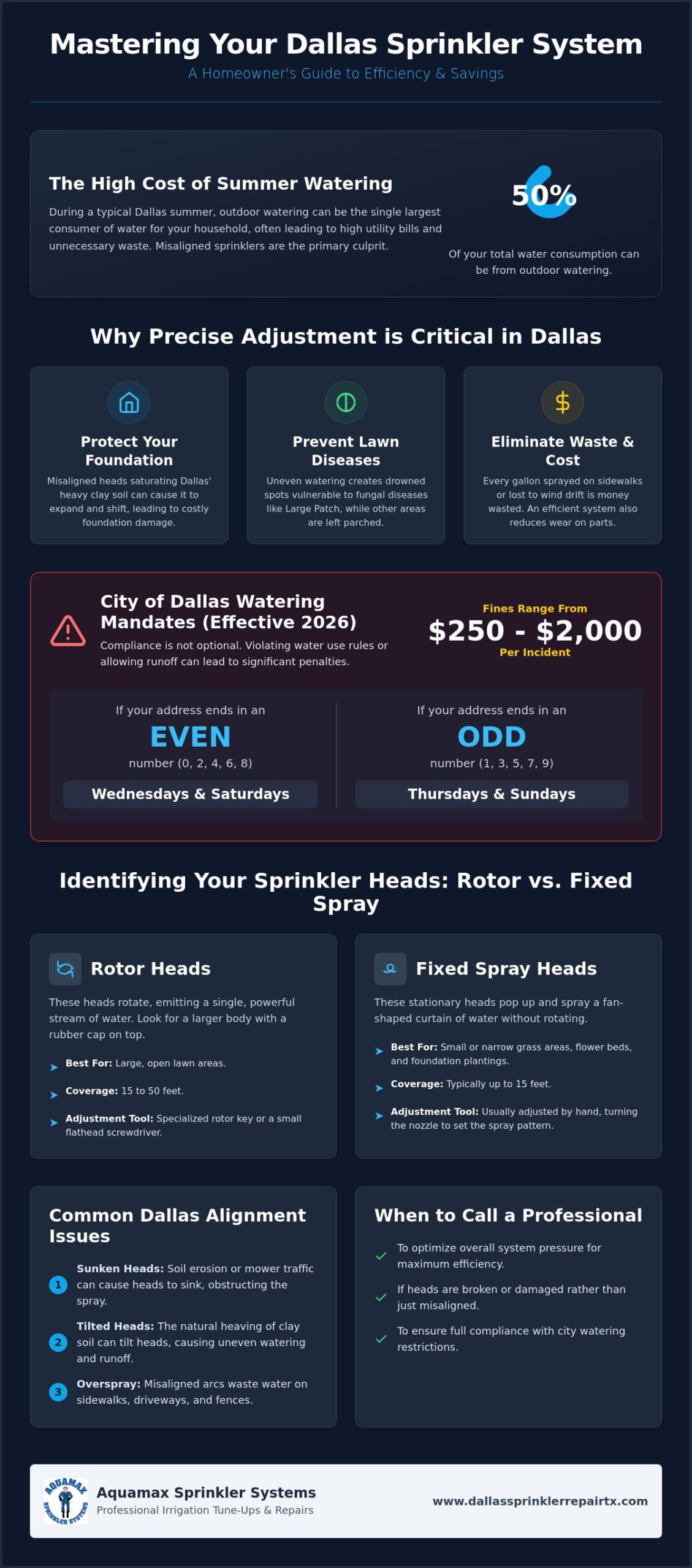
Did you know that outdoor watering can account for more than 50% of your total water consumption during a typical Dallas summer? It’s frustrating to watch your utility bill climb while your grass still looks parched in some spots and drowned in others. You likely already know that a misaligned system is the culprit, but finding the time for a proper sprinkler head adjustment Dallas project feels like a chore when you’re dealing with complex brand-specific screws and moving parts. It’s a common struggle for homeowners who want a beautiful landscape without the stress of wasting precious resources.
Key Takeaways
- Protect your home’s foundation from the damaging effects of over-saturation and runoff caused by misaligned sprinkler heads in North Texas clay soil.
- Identify the mechanical differences between rotors and fixed spray heads to ensure you use the correct adjustment technique for every zone in your yard.
- Master the step-by-step process for a DIY sprinkler head adjustment Dallas to achieve perfect spray patterns and eliminate wasteful over-spraying onto sidewalks.
- Learn how to troubleshoot regional issues like sunken or tilted heads caused by the natural shifting and heaving of local soil over time.
- Determine when a professional irrigation tune-up is necessary to optimize system pressure and ensure full compliance with 2026 Dallas watering restrictions.
Why Sprinkler Head Adjustment is Critical for Dallas Lawns
Precision in Dallas is more than an aesthetic choice; it’s a structural necessity. Our heavy clay soil expands when wet and shrinks when dry, creating a volatile environment for your home. If your sprinkler heads spray the base of your house instead of the turf, you risk foundation shifting that leads to massive repair bills. A proper sprinkler head adjustment Dallas project ensures water reaches the root zone without saturating your slab or wasting money on the driveway. It’s about protecting your most valuable asset while maintaining curb appeal.
Beyond foundation protection, alignment prevents fungal outbreaks that thrive in North Texas humidity. When heads are misaligned, some areas get drowned while others bake in the sun. This imbalance stresses the grass, making it vulnerable to diseases like Large Patch or Take-all Root Rot. Uniform coverage is your first line of defense against a patchy, sickly lawn. It ensures that every square inch of your sod receives exactly what it needs to survive the July heat.
To better understand the mechanical process of fine-tuning your system, watch this helpful video:
The Cost of Misaligned Sprinklers
Every gallon that hits your fence or sidewalk is a direct withdrawal from your bank account. In the open, windy landscapes of the DFW metroplex, “wind drift” often carries fine mist away from its target before it even touches the ground. Tightening your arcs and adjusting the trajectory of different types of irrigation sprinklers reduces this waste significantly. Beyond monthly utility bills, a well-balanced system reduces the workload on your hardware. When your heads are optimized, the system runs more efficiently, preventing premature wear on your valves and controller.
Dallas Watering Laws and Efficiency
Compliance isn’t optional in 2026. The City of Dallas mandates a maximum of two watering days per week based on the last digit of your address. Even-numbered addresses water on Wednesdays and Saturdays, while odd-numbered addresses are restricted to Thursdays and Sundays. Violating these rules or allowing water to runoff into the street can result in fines ranging from $250 to $2,000 per incident. Precision sprinkler head adjustment Dallas is the most effective way to meet the “no-runoff” requirement. If you discover that your heads are broken rather than just misaligned, seeking professional irrigation repair is essential to avoid these steep penalties.
Identifying Your Heads: Rotors vs. Fixed Sprays
Identifying your hardware is the essential first step for any sprinkler head adjustment Dallas project. Most North Texas irrigation systems rely on three industry leaders: Hunter, Rain Bird, or Weathermatic. While the brands differ, the heads themselves fall into two mechanical categories: rotors or fixed sprays. Knowing the difference ensures you don’t strip an adjustment screw or waste time on a broken component. Misidentifying a head often leads to improper watering patterns that can damage your turf during the peak of a Texas summer.
Rotor Heads: For Large Turf Areas
Rotor heads serve large, expansive sections of your lawn where water needs to travel 15 to 50 feet. They emit a single, concentrated stream of water that moves in a slow, steady arc. You’ll recognize these by their larger diameter and the rubber cap on the top. Most Dallas systems use gear-driven rotors, which operate silently. If you hear a repetitive “tink-tink-tink” sound, you have older impact rotors. To adjust these, you’ll need a specialized rotor key or a small flathead screwdriver to access the sockets on the cap. One socket controls the “arc,” which is the left-to-right travel, while the other controls the “radius,” which determines how far the water reaches.
Fixed Spray Heads: For Small Spaces and Beds
Fixed spray heads are stationary. They pop up and immediately release a fan-shaped curtain of water rather than a single rotating stream. These are ideal for flower beds, foundation plantings, and narrow strips of grass. Modern systems often use Variable Arc Nozzles (VAN). These allow you to manually twist the nozzle head to set the spray width from 0 to 360 degrees. If a nozzle is clogged with Dallas silt or physically cracked, it won’t respond to turning. These damaged parts require irrigation repair rather than simple alignment to prevent water waste.
Following Texas water conservation guidelines means ensuring every head is the right tool for the job. Using a rotor for a small flower bed leads to immediate runoff, while using a fixed spray for a large lawn creates frustrating dry patches. If your system seems mismatched or you’re struggling with different brands, a professional sprinkler system tune-up provides the expertise needed to recalibrate everything for peak performance. This ensures your landscape stays vibrant while keeping your water usage within local limits.
Step-by-Step Guide to Adjusting Your Sprinkler Heads
Performing a successful sprinkler head adjustment Dallas requires the right tools and a methodical approach. Before you begin, gather a small flathead screwdriver and a brand-specific rotor key. Hunter systems typically require a specialized white or grey plastic key with a T-handle. Rain Bird rotors generally utilize a standard flathead screwdriver for both arc and radius changes. Wearing waterproof boots is recommended because you must adjust the heads while the zone is active to see the actual spray pattern in real time.
Start with a “dry run” for your rotors. Before turning the water on, physically rotate the head to find the fixed left stop. If the left stop is pointing at your driveway instead of the turf, you must unscrew the internal riser or the entire head to reposition it. Once the left boundary is set, you can use your tools to fine-tune the right-side limit and the distance of the throw while the water is running. This ensures you don’t waste time making adjustments that look correct while dry but fail under pressure.
Adjusting Rotor Arc and Radius
- Locate the Sockets: Find the adjustment sockets on the rubber head cover. On a Hunter PGP, look for the “arc” socket marked with a plus and minus sign. On a Rain Bird 5000, look for the pull-up slot and the adjustment screw.
- Set the Arc: Insert your tool and turn clockwise to increase the swing or counter-clockwise to decrease it. This controls how far the head rotates from its fixed left stop.
- Control the Radius: Find the “break-screw” located above the nozzle. Tightening this screw into the stream breaks the water flow, which shortens the distance. This step is vital for preventing water from hitting your siding and contributing to foundation issues in our local clay soil.
Setting Fixed Spray Patterns
Fixed spray heads are simpler but require a firm grip. To change the direction, you can often “ratchet” the internal riser by twisting it until the spray points toward the lawn. If you have Variable Arc Nozzles (VAN), simply twist the top ring to open the fan wider or narrow it down to fit the specific corner of your flower bed. If the head is misting heavily, use your screwdriver to tighten the center screw on the nozzle. This reduces the flow and prevents the wind from blowing your water away before it hits the ground. If these manual steps reveal deeper issues like low pressure or leaks, it is time to contact a professional for irrigation repair to restore your system’s efficiency.
Troubleshooting Common Dallas Alignment Issues
Dallas homeowners face a unique challenge that most national DIY guides ignore: our soil is alive. The heavy clay in North Texas expands and contracts violently with moisture levels, a process known as soil heaving. This constant movement can tilt your heads, push them above the soil line, or cause them to sink below the thatch. Regular sprinkler head adjustment Dallas is necessary simply to keep up with the ground shifting beneath your feet. If you find that an adjustment screw turns infinitely without changing the spray arc, the internal gears are likely stripped. In these cases, a simple twist won’t solve the problem, and you’ll need a professional sprinkler repair Dallas to replace the internal assembly.
Physical obstructions are the second most common issue in DFW landscapes. Thick St. Augustine grass can quickly “swallow” a standard 4-inch pop-up head, blocking the water flow and creating dry patches. Bermuda grass, while shorter, grows densely around the base of heads and can prevent them from retracting fully. When a head doesn’t retract, it becomes a prime target for lawnmower blades. Always clear away excess grass and dirt from the perimeter of each head before attempting to recalibrate the spray pattern.
The Impact of Soil Movement
Because our regional clay acts like a slow-moving wave, a head that was perfectly vertical in March might be leaning at a 15-degree angle by July. These tilts ruin your “head-to-head” coverage, leaving some areas parched while others turn into muddy bogs. You should perform head inspections at least twice a year to identify these leaners. We recommend using “swing joints” or “funny pipe” during any repair. These flexible connections allow the head to move with the soil without snapping the rigid lateral pipe underneath. Straightening a tilted head often requires digging a small hole to reposition the riser, ensuring the spray remains parallel to the ground.
Clogged Nozzles and Low Pressure
Sometimes what looks like a misalignment is actually a clog. Dallas water can carry fine silt that settles in the filter screen directly beneath the nozzle. If a head has low pressure while others in the same zone are spraying fine, try flushing it. Pull the riser up, unscrew the nozzle, and turn the water on briefly to blow out any debris. If the pressure remains low across the entire zone, you might be dealing with a subsurface leak rather than a head issue. Consult your sprinkler system tune up Dallas checklist to verify that your valves and main lines are intact before you continue adjusting individual heads. If you’re overwhelmed by the technical requirements of a full system calibration, you can schedule a professional inspection to ensure every zone operates at peak efficiency.
Professional Tune-Ups: When to Call Aquamax
While a DIY sprinkler head adjustment Dallas project can resolve simple alignment issues, a professional system tune-up addresses the complex mechanics that govern your monthly water bill. Precision aiming is only one part of the efficiency equation. Our technicians perform comprehensive 2026 irrigation audits that evaluate the entire system’s health, from the main valve to the furthest nozzle. We use specialized pressure gauges to ensure every zone operates within its optimal PSI range. High pressure often leads to “misting,” where water evaporates in the North Texas heat before it ever touches your grass, while low pressure prevents rotors from completing their full rotation.
Upgrading to high-efficiency rotary nozzles is another proactive step we recommend for modern Dallas landscapes. These nozzles emit multiple rotating streams at a slower application rate, allowing our dense clay soil more time to absorb the moisture. This significantly reduces runoff and increases wind resistance, ensuring your water stays on your lawn even during a gusty afternoon. We also verify that your controller and mandated rain sensors are perfectly calibrated for current weather patterns, providing you with a “set it and forget it” solution that maintains compliance with local ordinances.
Why DIY Isn’t Always Enough
Hidden issues often mask themselves as simple alignment problems. A dry patch might look like a misdirected head, but it could actually be a weeping valve or a hairline fracture in a lateral line that only leaks under pressure. Our licensed technicians have been identifying these subtle failures since 1998. We utilize professional tools to measure the “precipitation rate” across your zones, ensuring that the water distribution is truly uniform. This scientific approach eliminates the guesswork of DIY adjustments and prevents the long-term damage caused by over-watering or under-watering specific sections of your property.
Book Your 2026 Maintenance
Protecting your landscape and your wallet requires a proactive approach to irrigation. If you have spent hours on a sprinkler head adjustment Dallas project and still see high bills or dry turf, it is time for a professional intervention. Our team provides the peace of mind that comes from knowing your system is handled by capable, licensed hands. We invite you to check out our current specials for DFW homeowners and read our reviews to see why your neighbors trust us with their property maintenance. Contact us today for a professional system evaluation and ensure your lawn remains a lush, vibrant asset all summer long.
Secure Your Landscape’s Future
Achieving uniform water coverage protects your home’s foundation from the volatile North Texas clay and ensures you stay compliant with the city’s 2026 watering schedule. Small changes, like setting a rotor’s arc or cleaning a clogged nozzle, lead to significant utility savings and a more resilient lawn. Mastering a sprinkler head adjustment Dallas project is a vital step in responsible property maintenance, but you don’t have to manage it alone. If your DIY efforts reveal deeper mechanical leaks or if you simply want the peace of mind that comes from a perfectly calibrated system, our team is ready to assist.
Our licensed and insured technicians have specialized in DFW soil and climate challenges since 1998. As A+ rated local irrigation experts, we understand exactly how to optimize your system for peak efficiency. Schedule your professional sprinkler tune-up with Aquamax today! We take the burden of maintenance off your hands so you can enjoy a lush, vibrant landscape all summer long. Your lawn’s vitality is our priority, and we’re here to help you achieve it.
Frequently Asked Questions
How do I adjust the spray distance on a Rain Bird sprinkler head?
Locate the small flathead screw on the top center of the rotor head to decrease the spray distance. Turn this screw clockwise to move the break-screw into the water stream, which shortens the throw. This adjustment is essential for keeping water off your house and preventing foundation issues in our local clay soil. Always make these changes while the zone is active to see the immediate impact on the radius.
Why does my sprinkler head keep hitting my fence even after I adjust it?
High water pressure or significant wind drift is likely causing the water to overshoot its intended target. If your system’s pressure is too high, the water atomizes into a fine mist that carries much further than a solid stream. You may need to tighten the radius screw further or install pressure-regulating heads. This ensures your sprinkler head adjustment Dallas project actually results in water reaching the turf rather than the wood.
How often should I check the alignment of my sprinkler heads in Dallas?
Inspect your system’s alignment at least twice a year, specifically in early spring and mid-summer. The shifting North Texas clay soil frequently causes heads to tilt or sink as moisture levels change. Regular inspections help you avoid fines from Dallas watering restrictions and ensure your lawn survives the peak July heat. A quick check after every third or fourth mow is also a good practice to spot mower damage.
Can I adjust my sprinkler heads while the water is turned off?
You can set the initial left-hand stop while the water is off, but final calibration requires the system to be running. Seeing the actual spray pattern under full pressure is the only way to ensure precision and uniform coverage. Use a brand-specific rotor key or a flathead screwdriver to make fine-tuned changes while the zone is active. This method prevents the guesswork that leads to dry patches or wasted water.
What tools do I need to adjust Hunter rotor heads?
A Hunter adjustment wrench, commonly called a rotor key, is the primary tool needed for these heads. This plastic T-handle tool features a hex end for arc changes and a flat-blade end for radius reduction. While a small flathead screwdriver can work on some models, the specialized key prevents you from stripping the plastic adjustment sockets. Keep this tool in an accessible spot for quick seasonal tune-ups.
Why is water misting instead of spraying in a solid stream?
Misting is a primary symptom of excessive water pressure within your irrigation zone. When water is pushed through a nozzle too fast, it breaks into tiny droplets that evaporate or blow away before hitting the grass. You can often reduce misting by turning the radius screw clockwise to restrict the flow at the head. If misting persists across the entire zone, you may need a professional to check your pressure vacuum breaker.
Is it better to adjust the nozzle or the entire sprinkler head body?
Adjust the nozzle for spray pattern issues, but reposition the entire body for height or tilt problems. If a head is leaning due to soil heaving, you must dig it out and straighten the body to restore head-to-head coverage. Use the built-in adjustment screws on the nozzle for arc and distance changes. Attempting to twist the entire body to change a spray direction can sometimes loosen the connection to the lateral pipe.
When should I stop trying to adjust and just replace the sprinkler head?
Replace the head immediately if the adjustment screw turns infinitely without changing the spray pattern or if the riser fails to retract. These symptoms indicate stripped internal gears or a failed spring, which cannot be fixed with a standard sprinkler head adjustment Dallas. Using a broken head wastes water and can lead to localized flooding. Swapping a damaged head for a new, high-efficiency model is a cost-effective way to maintain your system’s performance.