

Article by
Robert Maxvill
Owner of Aquamax Sprinkler Systems, American Sprinkler Repair and Dallas Drainage Systems.
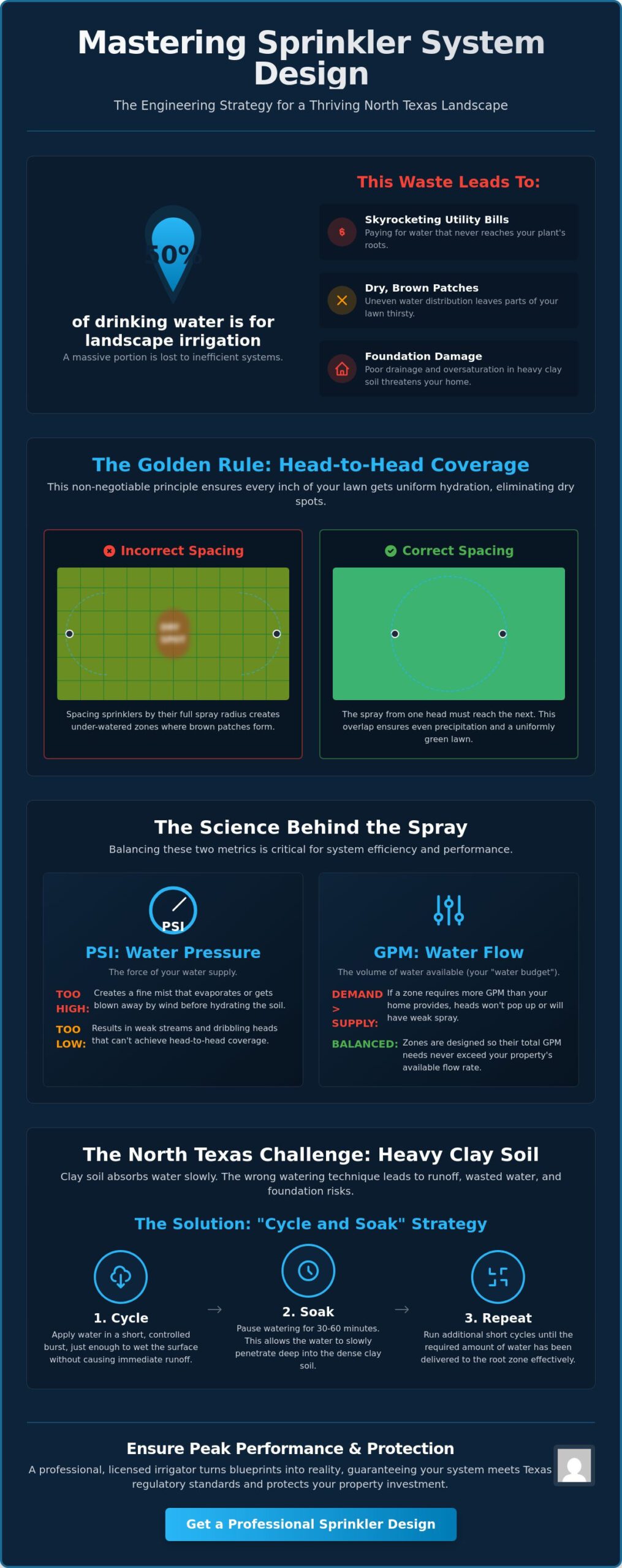
Did you know that nearly 50% of the drinking water used in North Texas goes toward landscape irrigation, yet a massive portion of that is lost to inefficient systems and overspray? It’s frustrating to watch your utility bills climb while your lawn develops stubborn brown patches and your foundation shifts in the unforgiving Plano clay. You want a vibrant yard, but the fear of wasted water and structural damage often makes irrigation feel like a gamble. You deserve a landscape that thrives without compromising your home’s integrity.
Mastering a professional sprinkler system design transforms this process from guesswork into a precise engineering strategy that protects your property. By aligning your irrigation plan with local environmental demands, you can ensure every drop reaches the root zone instead of the sidewalk. This guide explores the technical essentials of hydraulic planning, including how to manage “cycle and soak” needs in heavy soil and why the right blueprint is your best defense against the Texas heat. We will examine the core components of a water-efficient layout that lowers costs and secures your home’s foundation for years to come.
Key Takeaways
- Learn how to achieve head-to-head coverage to eliminate dry patches and ensure every inch of your lawn receives uniform hydration.
- Understand how technical metrics like PSI and GPM influence your sprinkler system design to prevent wasted water and equipment damage.
- Discover why Plano’s heavy clay soil requires a “cycle and soak” strategy to maximize absorption and protect your home’s foundation.
- Identify how to map your landscape’s unique microclimates to create customized hydrozones that cater to specific plant needs.
- Recognize the performance benefits and legal requirements of working with a licensed irrigator to ensure your system meets Texas regulatory standards.
The Fundamentals of Efficient Sprinkler System Design
Professional sprinkler system design is the strategic mapping of water distribution across a specific property. It is far more than just burying pipes in the ground; it is a complex engineering task that balances hydraulic pressure with the unique needs of your vegetation. In Plano, where summer temperatures frequently climb above 100 degrees, an inefficient layout leads to immediate plant stress. A well-engineered plan ensures that every square foot of turf receives the precise volume of water it needs without wasting a drop on your driveway or the side of your house.
Efficient design serves as your first line of defense in water conservation. Research indicates that in urban areas of Texas, about 40-50% of drinking water is used for landscape watering. A significant portion of this is often lost to evaporation or runoff caused by poor planning. While residential designs focus on protecting home foundations and navigating tight property lines, commercial systems prioritize high-durability components and large-scale coverage. Both require a deep understanding of hydraulic physics to function correctly. If you are considering a new sprinkler system installation, starting with a professional blueprint is the only way to guarantee long-term performance.
Why Head-to-Head Coverage is Non-Negotiable
You might assume that if a sprinkler head sprays 15 feet, you should place the next head 15 feet away. This is a common mistake that leads to dry spots. Every irrigation sprinkler distributes more water at the end of its arc than it does at the base. To achieve uniform precipitation, the spray from one head must reach the base of the next head in every direction.
This overlap, known as head-to-head coverage, is essential for eliminating brown patches. In North Texas, the “wind factor” complicates this further. Steady breezes can drift fine mist away from its intended target before it even hits the ground. A professional sprinkler system design compensates for this by tightening head spacing and selecting low-angle nozzles. Without this overlap, you’ll find yourself overwatering the entire lawn just to green up a single dry spot, which quickly inflates your utility costs.
The Role of the Mainline and Lateral Pipes
Think of your irrigation system like the circulatory system in your body. The mainline is the primary artery. It remains under constant pressure from the water meter to the zone valves. Because it’s always “live,” the mainline must be constructed with high-grade materials to prevent bursts. If the mainline fails, the entire system is compromised.
Lateral lines are the smaller pipes that branch out from the valves to the individual heads. These only hold water when a specific zone is active. Proper pipe sizing is critical for these lines. If the pipes are too narrow, friction loss will drop the water pressure before it reaches the last head in the line. This results in weak spray patterns and uneven coverage. Every pipe diameter must be calculated based on the required flow rate to maintain consistent pressure from the first head to the last.
Technical Metrics: PSI, GPM, and Hydrozones
Successful sprinkler system design relies on two non-negotiable numbers: PSI and GPM. Without these metrics, you are simply guessing how many heads your pipes can support. PSI, or pounds per square inch, measures the static and dynamic force of your water supply. If your pressure is too high, your system will produce a fine mist that evaporates before it hits the grass. Utilizing WaterSense labeled spray sprinkler bodies with built-in pressure regulation can help stabilize this force and protect your components. Conversely, low pressure results in weak streams that fail to achieve the head-to-head coverage mentioned earlier.
GPM, or gallons per minute, represents the total volume of water available to your property at any given time. Think of this as your water budget. Every sprinkler head “spends” a specific amount of GPM. If your zone requires 12 GPM but your home only provides 10, the heads won’t pop up correctly. Professional hydraulic calculations ensure your zones are divided so the demand never exceeds the supply. If the math seems daunting, a professional new sprinkler system installation guarantees that these technical variables are balanced for peak efficiency.
Calculating Your Home’s Water Capacity
To find your home’s capacity, look at the side of your water meter, which is usually found in a concrete box near the street. Most residential meters in Plano are 5/8-inch or 3/4-inch. You also need to measure your service line diameter. PSI is the pressure that pushes water through these pipes, and keeping it within the 30 to 50 PSI range prevents wasteful misting. For a rough GPM estimate, perform a bucket test by timing how many seconds it takes to fill a one-gallon container from an outside faucet. Divide 60 by that number of seconds to get your GPM.
Hydrozoning: Watering Smarter, Not Harder
Effective sprinkler system design also incorporates hydrozoning, which is the practice of grouping plants with similar water requirements. Turfgrass, for instance, requires frequent, deep watering, while established shrubs may only need a fraction of that volume. By placing them in separate zones, you avoid overwatering one area to save another.
Sun exposure is the final variable. A north-facing flower bed in the shade of your home loses water much slower than a south-facing lawn in full sun. Dedicated zones for shady microclimates prevent the soggy soil and root rot that often plague generic system layouts. This precision is what separates a basic irrigation setup from a high-performance landscape asset. By tailoring the delivery to the specific microclimate, you ensure every plant survives the Texas heat without inflating your utility bill.
The North Texas Challenge: Designing for Clay Soil
Plano sits on the “Black Land Prairie,” a region characterized by heavy clay soil that behaves differently than the sandy or loamy soils found in other parts of the country. This soil is notorious for its poor infiltration rate. It absorbs water very slowly but holds onto it for a long time once saturated. If your sprinkler system design applies water faster than the clay can drink it, the excess simply runs off into the street. This waste is a primary cause of high utility bills and localized flooding in North Texas yards.
To combat this, a professional irrigation plan must incorporate the “cycle and soak” method. This strategy involves breaking a single long watering period into multiple shorter cycles with at least an hour of rest in between. For example, instead of running a zone for 15 minutes once, you might run it for five minutes three times. This allows the clay to pull moisture deeper into the root zone through capillary action. Implementing these Landscape Irrigation Best Management Practices ensures your lawn stays hydrated without creating a swampy mess or violating Plano’s twice-per-week watering restrictions.
Foundation Drip Lines: A DFW Essential
In North Texas, your irrigation system isn’t just for your grass; it’s a vital tool for protecting your home’s structural integrity. Clay soil expands when wet and shrinks when dry. This constant movement puts immense pressure on your concrete slab, often leading to costly foundation cracks. A dedicated drip irrigation system installation around the perimeter of your home provides the consistent moisture levels needed to stabilize the soil.
Standard spray heads are inefficient for this task because they lose too much water to evaporation and wind drift. Drip lines are buried or pinned 12 to 18 inches from the foundation, delivering water directly to the soil where it’s needed most. This targeted approach prevents the soil from pulling away from the slab during the peak of the Texas summer, offering peace of mind that a standard lawn zone simply cannot provide.
Managing Runoff in Clay Environments
Elevation changes in your yard significantly impact zone pressure and water distribution. Water naturally migrates to the lowest point of your property, which can lead to pooling and root rot if your sprinkler system design doesn’t account for slopes. Using slow-application rotary nozzles is a professional solution. These heads apply water at a rate of 0.4 to 0.6 inches per hour, which is much closer to the absorption rate of clay than traditional spray heads that dump 1.5 inches per hour.
When design alone can’t solve the problem, you may need to integrate yard drainage solutions Dallas homeowners rely on to move excess water away from the house. Proper grading and French drains work in tandem with your irrigation layout to prevent standing water. By balancing intake with effective drainage, you create a self-sustaining environment that thrives despite the challenging North Texas geology.
Mapping Your Landscape: Head Selection and Layout
Mapping is where your sprinkler system design takes physical shape. Start with a scale drawing of your property. You must include permanent structures like your home, driveway, and fences. These obstacles dictate where you can and cannot run lateral lines. Once the boundaries are set, mark your microclimates. Identifying which areas face the relentless Texas sun and which remain in the shade allows you to group zones effectively. This step prevents the common mistake of overwatering shaded flower beds just to keep a sunny lawn green.
After sketching the yard, select your head types. Large, open turf areas require gear-driven rotors. These are designed for distances over 15 feet. For smaller garden beds or tight side yards, use pop-up spray heads. They provide the precision needed for complex corners. You must never mix rotors and sprays on the same zone. Because they have vastly different precipitation rates, mixing them will leave one area flooded while another remains parched. A precise sprinkler system design ensures that each zone uses only one type of head to maintain uniform water application.
Plot your head placement to ensure 100% overlap. As discussed, head-to-head coverage is the only way to eliminate dry spots. Finally, determine your valve box and controller locations. Place valve boxes in accessible areas that aren’t prone to pooling water. Your controller should be mounted in a spot where you can easily reach it for manual adjustments, though modern technology often makes this unnecessary. If you’re ready to move from a sketch to a professional installation, schedule a consultation for a new sprinkler system installation today.
Rotors vs. Spray Heads
Use gear-driven rotors for any area requiring a throw of 15 to 50 feet. These heads rotate slowly, allowing the water to soak into the clay soil more effectively. Pop-up spray heads are better for distances under 15 feet. They are ideal for narrow strips of grass or flower beds where overshooting would hit the house. Mixing these head types on a single zone is a major design error that causes uneven water distribution and wasted resources.
Smart Controllers and Weather Sensors
Modern irrigation relies on smart controllers that connect to local Wi-Fi. These devices use real-time weather data to adjust your watering schedule based on actual rainfall in Plano. This shift toward sophisticated digital management is much like the professional approach taken by Straight Street Event Services, which provides technical solutions for live and hybrid environments. Rain and freeze sensors are equally important, shutting down the system during a storm or when temperatures drop to prevent hazardous ice. By integrating these advanced tools, you can manage your entire system from a smartphone, giving you total control over your landscape’s health from anywhere in the world.
Professional Installation: Turning Blueprints into Reality
A sophisticated sprinkler system design requires more than just a shovel and a weekend. In Texas, the law is clear: any installation connecting to a public water source must be performed or supervised by a licensed irrigator. This regulation exists to protect the public water supply and ensure systems meet strict hydraulic standards. DIY installations often skip the permitting process, which in cities like Plano includes a mandatory pre-irrigation inspection and a final pressure test while trenches are still open. Without these professional checks, you risk installing a system that underperforms or leaks beneath your lawn, potentially causing the foundation issues we discussed earlier.
Beyond legality, the technical risks of a self-installed system are significant. Improper trenching can damage existing utility lines, while incorrect pipe sizing leads to the pressure drops that ruin head-to-head coverage. A professional installation transforms your blueprint into a high-efficiency asset that adds real value to your property. You can find more details on our specialized approach by visiting our sprinkler installation service page.
The Importance of Backflow Prevention
Backflow devices are the silent guardians of your household’s health. They prevent “back-siphonage,” a phenomenon where a sudden drop in city water pressure pulls contaminated irrigation water into your home’s drinking pipes. This water often contains lawn chemicals, fertilizers, or stagnant bacteria. Because of this risk, the City of Plano Utility Operations Department requires backflow prevention devices to be tested and certified by a registered professional upon installation and every year after. Illegal straight-pipe connections are not just against the law; they are a direct threat to your community’s safety. Our team ensures every device is properly installed, tested, and registered to keep your water clean.
Why Choose Aquamax for Your Design?
Aquamax Sprinkler Systems has provided reliable irrigation solutions across the DFW region since 1998. We don’t just install parts; we build sustainable ecosystems. Our technicians are licensed, insured, and deeply familiar with the unique environmental challenges of North Texas. We prioritize high-grade components that withstand the expansion and contraction of our local clay soil. This commitment to quality ensures your sprinkler system design remains functional for decades, not just a few seasons. If you want the peace of mind that comes from professional expertise, contact our team today to schedule your custom design consultation. We are ready to help you achieve a lush, water-efficient landscape that survives the Texas heat.
Secure Your Landscape’s Vitality
A high-performance landscape in Plano requires more than just water; it demands a calculated strategy. You’ve seen how technical metrics like PSI and GPM dictate the health of your turf, and why the “cycle and soak” method is the only way to manage our local clay soil. By prioritizing head-to-head coverage and foundation-specific drip lines, you protect both your lawn’s vitality and your home’s structural integrity.
Professional sprinkler system design is an investment in long-term efficiency and peace of mind. Aquamax Sprinkler Systems has served the DFW area since 1998, providing the licensed and insured expertise necessary to navigate complex Texas irrigation regulations. Our team specializes in the seamless integration of custom drainage and irrigation to ensure your property remains a thriving sanctuary. Don’t leave your property’s health to chance or uncertified hands.
Get a Professional Sprinkler Design Consultation Today and start building a more resilient, water-efficient home. Take the first step toward a lush, worry-free yard that stands up to the Texas sun.
Frequently Asked Questions
Do I need a permit for a new sprinkler system in Plano?
Yes, you must obtain a permit for any new irrigation installation in the City of Plano. Texas House Bill 1656 requires a formal permitting and inspection process for municipalities with populations over 20,000. This includes a pre-irrigation inspection with open trenches and a final inspection once the work is complete. A licensed irrigator should handle this process to ensure your system meets all state and local safety regulations.
How many sprinkler heads can I have on one zone?
The number of heads per zone is limited by your home’s total Gallons Per Minute (GPM) capacity. You must calculate the GPM requirement for every head you plan to use and ensure the sum doesn’t exceed your available water flow. If you put too many heads on one valve, the water pressure will drop. This results in heads that fail to pop up or spray their intended distance, leaving your lawn parched.
What is the best time of day to water my lawn in North Texas?
Early morning is the most effective time to water, ideally before 10 a.m. Plano’s watering schedule prohibits the use of sprinklers between 10 a.m. and 6 p.m. from April 1 through October 31 to minimize evaporation. Watering in the early hours allows moisture to penetrate the clay soil before the sun’s heat intensifies. During the winter, it’s better to water during the day to avoid creating ice on sidewalks.
Can I design my own sprinkler system using a Google Map?
While a satellite image helps you sketch property boundaries, it isn’t a replacement for a professional sprinkler system design. Google Maps can’t measure your specific PSI, GPM, or the subtle elevation changes that cause runoff in clay soil. A functional design requires on-site hydraulic calculations and a physical assessment of your landscape’s microclimates. Relying on a map alone often leads to inaccurate head spacing and expensive dry spots.
How much does a professional sprinkler system design cost?
The cost of a custom irrigation plan depends on your property’s square footage and the complexity of your landscape features. Large estates with significant elevation changes or varied plant life require more detailed hydraulic mapping than a standard rectangular lot. While the design is an initial investment, it prevents the long-term costs of wasted water and foundation repairs. You should request a personalized consultation to get an accurate estimate for your yard.
Should I use drip irrigation or spray heads for my flower beds?
Drip irrigation is the superior choice for flower beds and foundation perimeters in Plano. It delivers water directly to the soil at a slow rate, which is perfect for the low infiltration speed of North Texas clay. Spray heads often lose water to wind drift and evaporation, and wet foliage can encourage fungal growth on sensitive plants. Drip systems keep the root zone consistently moist while keeping the rest of your garden dry.
How do I find my water pressure for my irrigation design?
You can find your static water pressure by attaching a pressure gauge to an outdoor hose bib. Ensure all other water sources in your home are turned off before taking the reading to get the most accurate result. This PSI measurement is a foundational part of your sprinkler system design. It tells you exactly which types of heads your system can support and how many can run simultaneously without losing performance.
What happens if my sprinkler heads do not overlap?
If your heads don’t overlap, you’ll see “donuts” or brown patches where the grass isn’t getting enough water. Most heads are designed to spray more water at the end of their arc than at the base. To achieve uniform coverage, the spray from one head must reach the base of the next head. Without this head-to-head overlap, you’ll be forced to overwater the entire zone just to reach the dry gaps between heads.