

Article by
Robert Maxvill
Owner of Aquamax Sprinkler Systems, American Sprinkler Repair and Dallas Drainage Systems.
Did you know that annual direct runoff in a developed Dallas neighborhood is now double that of undeveloped land? If you’ve watched a “moat” form around your house after a heavy storm, you know the frustration of standing water that refuses to budge. It’s more than just a soggy lawn; it’s a direct threat to your home’s structural integrity. Many homeowners fear the high costs of foundation repair, yet they continue to battle mosquito breeding grounds every time the clouds gather. Professional French drain installation Dallas residents rely on is the most effective way to intercept this water before it causes permanent damage.
You can protect your investment by mastering the essentials of yard drainage designed specifically for our local environment. This guide explores how to handle the heavy clay soil common in North Texas and the increasing intensity of urban flooding. We’ll outline the critical components of a successful drainage system, from proper grading to the legal requirement of calling 811 before any excavation begins. By the end of this 2026 guide, you’ll understand how a strategically placed system provides the peace of mind that comes with a dry, stable property.
Key Takeaways
- Understand why Dallas clay and intense flash flooding require a specialized approach to manage subsurface groundwater effectively.
- Learn how professional French drain installation Dallas experts determine the precise trench depth and pipe materials needed to handle high-volume runoff.
- Identify the critical differences between surface drains for immediate downspout runoff and French drains for saturated soil conditions.
- Discover the technical steps of a professional installation, including the use of laser levels for accurate slope and the legal necessity of utility marking.
- Master simple maintenance strategies, such as checking discharge points and using clean-outs, to ensure your drainage system remains functional for years.
Why Dallas Properties Require Specialized French Drain Installation
A French drain is a sub-surface interceptor designed to redirect groundwater before it reaches your home’s foundation. In North Texas, flash flooding often overwhelms standard yard grading. When heavy rain hits the DFW area, the volume of water can quickly transform a manicured lawn into a swamp. Without a professional drainage system installation, this water sits and begins to exert hydrostatic pressure against your home’s structural base. This pressure isn’t just a nuisance; it’s a physical force that can crack concrete and shift entire walls.
Dallas sits atop the “Blackland Prairie,” a region defined by its dense, dark clay soil. This isn’t just dirt. It’s a shifting material that reacts aggressively to moisture changes. This clay has high elasticity, meaning it absorbs water and expands significantly, then shrinks and cracks during dry summer months. This cycle is why specialized French drain installation Dallas homes require focuses on stabilizing the soil moisture around the perimeter. By managing the water table, you minimize the “heave” that destroys local foundations.
The Link Between Drainage and Foundation Health
North Texas clay is notorious for shifting. When water pools near your foundation, the soil expands and pushes upward or inward. For pier-and-beam homes, this moisture can rot wooden supports or cause piers to settle unevenly. A French drain acts as your first line of defense by catching water in a gravel-filled trench and whisking it away through a perforated pipe. Consistent moisture management is the silent guardian of a crack-free foundation. By controlling the water levels around your home, you prevent the dramatic soil movements that lead to expensive structural repairs.
Signs Your DFW Yard Needs a French Drain
You don’t always need a major flood to know you have a problem. Look for these indicators in your yard:
- Spongy Turf: If your grass feels like a wet sponge three days after the rain stops, your soil is oversaturated.
- Efflorescence: Look for white, powdery salt deposits on crawlspace walls or concrete. This is a clear sign of water seeping through the masonry.
- Wall Cracks: New cracks in the drywall or doors that suddenly stick often point to moisture-related soil expansion.
While simple surface grading works for minor puddles, a French drain installation Dallas residents choose is necessary when the ground itself remains waterlogged. If your property has a high water table or sits at the bottom of a slope, subsurface drainage is the only way to keep your landscape healthy and your foundation stable.
The Anatomy of a High-Performance French Drain System
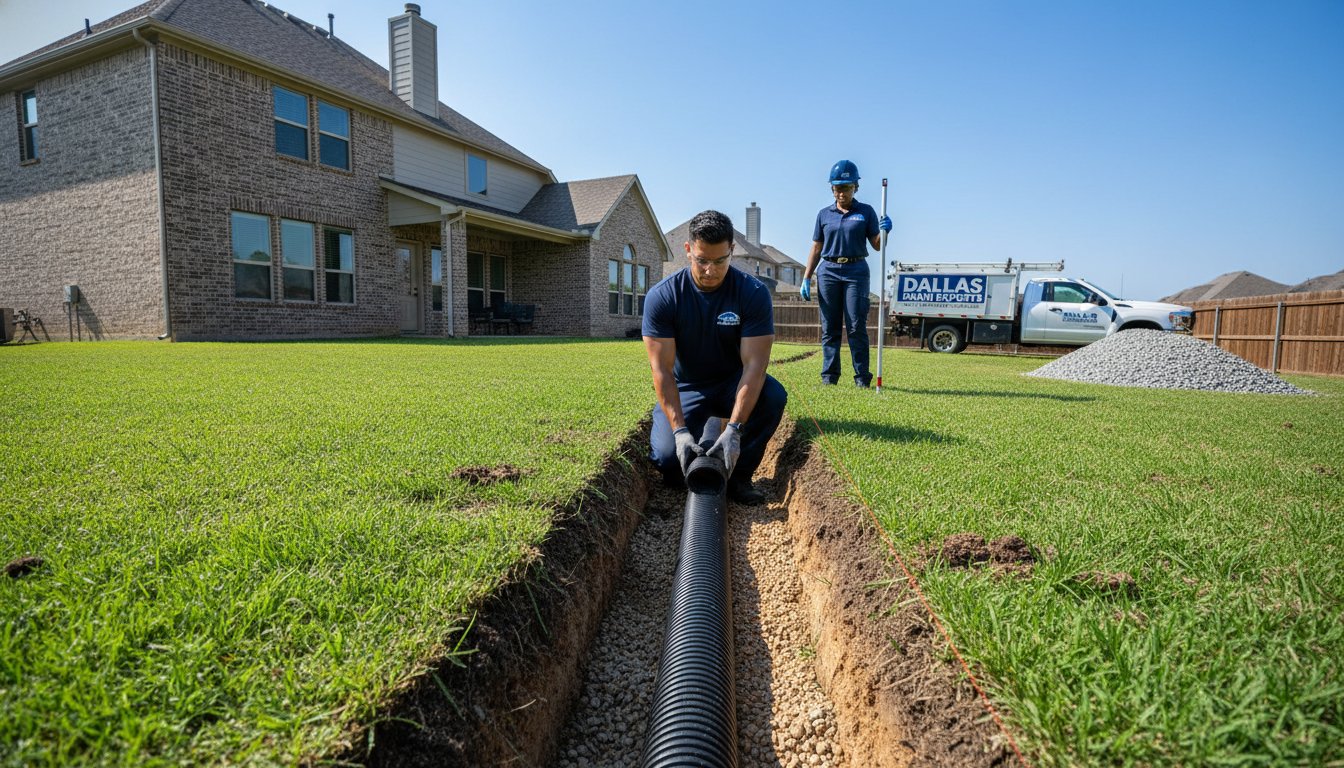
Building a drainage system that survives the unique pressures of North Texas requires more than just digging a ditch. A successful French drain installation Dallas project relies on a precise combination of depth, high-quality materials, and filtration. The trench serves as the primary collection point. For Dallas runoff volumes, a standard trench should be at least 12 inches wide and deep enough to maintain a consistent slope toward the discharge area. This ensures that water doesn’t just sit in the pipe but moves rapidly away from your foundation.
The choice of aggregate is equally vital. We use washed river rock or clean gravel to fill the trench. Unlike crushed limestone, which can break down and create its own sediment, washed river rock provides large voids that allow water to flow freely. This aggregate acts as the primary filter, slowing down the water and stripping away larger debris before it ever reaches the drainage pipe. If you are unsure about your current yard levels, a professional drainage system installation can ensure the physics of the system work in your favor.
Choosing the Right Pipe and Aggregate
Pipe durability is a non-negotiable factor in the Blackland Prairie. While many DIY kits use thin, corrugated plastic rolls, professional French drain installation Dallas experts utilize 4-inch NDS or Schedule 40 rigid PVC. These materials withstand the immense pressure of expanding clay without collapsing or “bellying.”
- Perforated Pipe: These pipes are installed with the holes facing down. This allows the water table to rise into the pipe from below and be carried away.
- Solid Pipe: Once the water has been collected, solid pipes transport it safely to the street or a bubbler pot without leaking back into the soil.
Avoid the “sock” pipes commonly found at big-box hardware stores. In our local clay, these thin fabric sleeves clog within a single season. A much larger filtration envelope is required to keep the system breathing over the long term.
The Critical Role of Filter Fabric
Non-woven geotextile fabric is the secret to a long-lasting drain. This material lines the entire trench before any rock or pipe is added. It acts as a permanent barrier between the native clay and your clean gravel. Without it, the fine silt from Dallas soil will eventually migrate into the rock. This causes “soil bridging” and effectively seals off the drain. A properly lined trench ensures that water can permeate the system while keeping the clay particles exactly where they belong. If you’re seeing signs of failure in an existing system, it’s often due to a lack of this critical filtration layer.

French Drains vs. Surface Drains: Which Does Your Property Need?
Choosing between a surface drain and a French drain depends entirely on where your water originates. Surface drains, often called catch basins, are designed to collect water that sits on top of the ground or hard surfaces. In contrast, French drains address water that has already soaked into the soil. Most Dallas properties suffer from both issues due to the high clay content in our local soil. A comprehensive drainage system installation often utilizes a hybrid approach to ensure complete property protection.
When to Choose a Catch Basin
If you see immediate pooling on your driveway, pool deck, or patio during a storm, a catch basin is the right tool. These systems use a grated box to capture large volumes of water quickly. They’re essential for directing gutter downspout water safely away from your home’s foundation. Managing this drainage for standing water in yard prevents the soil near your concrete from becoming a slurry. Catch basin installation serves as the fast-response tool of water management, handling visible runoff before it has a chance to sink in.
When a French Drain is Non-Negotiable
Groundwater is a slower, more persistent threat. You need a French drain when water seeps into crawlspaces or keeps low-lying flower beds perpetually soggy. These systems are also critical for protecting retaining walls. Without a way to relieve the pressure of saturated soil, a retaining wall can lean or collapse under the immense weight. Professional yard drainage solutions Dallas homeowners trust often prioritize the French drain as the core strategy for foundation stability. It works silently beneath the surface to intercept groundwater before it reaches your structural base.
Many DFW homeowners find that a single solution isn’t enough. We often recommend hybrid systems that link surface catch basins and French drains into a single exit pipe. This configuration handles the deluge from your roof while simultaneously drying out the subsoil. In larger landscapes, we might also incorporate natural swales. These shallow, grass-lined channels act as a secondary accompaniment to your sub-surface drainage, guiding overflow toward the street during extreme weather events. Proper French drain installation Dallas residents invest in should always account for these varying water sources to prevent future property damage.
Step-by-Step: The Professional French Drain Installation Process
Professional French drain installation Dallas starts with a rigorous site assessment. We don’t guess where the water goes; we use laser levels to map the yard’s natural “fall.” This identifies the exact path of least resistance for runoff. Before the first shovel hits the ground, we contact 811 for utility marking. In the DFW area, hitting a gas or water line is a dangerous and expensive mistake. Marking these lines ensures the project proceeds safely and remains code-compliant from start to finish.
A successful French drain installation Dallas residents can rely on depends on the quality of the trenching. Once the path is clear, we maintain a minimum 1% grade to ensure gravity does the heavy lifting. We then line the entire trench with non-woven geotextile fabric. Next, we add a base layer of washed stone, place the perforated pipe, and surround it with more aggregate. This layering technique prevents the pipe from shifting and ensures maximum filtration area. By the time we’re ready to backfill, the system is a high-capacity channel ready for the next North Texas storm.
Engineering the Proper Slope
Precision is everything in drainage engineering. The industry standard for DFW is a drop of at least 1/8 inch per foot. This might seem minor, but it’s the difference between a dry yard and a stagnant trench that breeds mosquitoes. If your yard is exceptionally flat, we integrate a sump pump into the design to provide the necessary mechanical lift. Without a continuous downward path, sediment settles and the system eventually fails. Water always wins if the slope is wrong.
Backfilling and Sod Restoration
The final steps determine the longevity and aesthetics of the work. We use permeable soil or sand caps over the gravel layers. This allows surface water to enter the system quickly while protecting the filtration fabric from sunlight and surface debris. We then carefully reapply the turf to ensure a seamless look. Our goal is to make the installation invisible once the grass recovers. If your lawn has suffered during the process, professional sod installation provides an immediate, lush finish to your newly drained landscape.
Don’t wait for the next flash flood to test your yard’s limits. Contact us today to schedule your professional drainage system installation and protect your property for years to come.
Protecting Your Investment: Maintenance and Professional Expertise
Even the most robust French drain installation Dallas has to offer requires periodic maintenance to ensure it remains effective over the long term. A drainage system is a mechanical asset rather than a “set it and forget it” feature. Professional designs include clean-outs; these vertical risers allow us to flush the system with water to clear any accumulated sediment. Without these access points, a blockage deep within the pipe could necessitate digging up the entire yard. Perform an annual inspection of your discharge points every spring. Clear away overgrown grass, mulch, or rodent nests that might obstruct the exit. If water can’t leave the pipe, it will back up and saturate the soil you’re trying to protect.
DIY French drains often fail within the first two years. Homeowners frequently skip the non-woven geotextile fabric or use thin, corrugated pipe that collapses under the weight of wet Dallas clay. These shortcuts save money initially but lead to foundation risks later. Trusting a specialist ensures that the engineering, from the aggregate choice to the exact slope, is handled correctly the first time. A professional drainage system installation provides the peace of mind that your home is guarded against the most severe North Texas weather cycles.
How to Spot a Failing French Drain
You must act quickly if you notice signs of system fatigue. During a storm, check your exit point. If water is only trickling out while your yard is flooding, you likely have an internal obstruction. Look for “blowouts” or sudden sinkholes appearing along the original trench line. These occur when water cannot escape the pipe and forces its way through the surrounding soil instead. If you see these red flags, it’s time to call for professional irrigation repair or drainage cleaning to prevent foundation shift.
Why Aquamax Sprinkler Systems is the Dallas Choice for Drainage
We have specialized in the vital intersection of irrigation and drainage since 1998. Our team consists of licensed and insured technicians who possess a deep understanding of North Texas geology and the specific challenges of Blackland Prairie clay. We don’t just move water; we engineer systems that preserve the structural integrity and aesthetic beauty of your property. Our long-standing reputation is built on reliability, functional excellence, and a proactive approach to property maintenance. Schedule your professional drainage assessment with Aquamax Sprinkler Systems today to ensure your home remains dry and stable through 2026 and beyond.
Secure Your Property Against North Texas Storms
Protecting your foundation starts with understanding the unique demands of local soil. We’ve explored how high-performance materials, precise sloping, and routine maintenance create a drainage system that lasts for decades. A generic approach simply won’t survive the aggressive expansion and contraction of our regional clay. Investing in a professional French drain installation Dallas project ensures that groundwater is intercepted before it can compromise your home’s structural base.
Since 1998, our team has provided custom engineering solutions specifically designed for the North Texas environment. Our licensed and insured technicians handle every technical detail, from laser-level site assessments to seamless sod restoration. You don’t have to face the next rainy season with the fear of standing water or expensive foundation cracks. Take the first step toward a dry, stable property today.
Get a Professional Drainage Estimate from Aquamax Sprinkler Systems and enjoy the peace of mind that comes with expert water management. Your landscape is a vital investment; let’s keep it healthy and thriving.
Frequently Asked Questions
How much does French drain installation cost in Dallas?
The total investment for a drainage system depends on the linear footage, the depth of the trench, and the specific landscape challenges involved. Factors such as soil density and the proximity to the foundation also influence the scope of work. Because every Dallas property has unique grading needs, you should request a professional site assessment to receive a precise quote tailored to your yard’s topography.
Do French drains require a permit in Dallas or Plano?
Most residential drainage projects in Dallas don’t require a permit if the system doesn’t connect to a municipal sewer or alter the natural runoff flow from the property. However, a permit is generally required if your project involves affecting a wetland or discharging water near a well. Always verify current local regulations with the City of Dallas Development Services before you begin any major excavation work.
How deep should a French drain be in North Texas clay?
A French drain in North Texas should typically be installed between 12 and 24 inches deep to effectively intercept groundwater before it reaches your foundation. The exact depth is determined by the “fall” required to maintain a consistent gravity flow. Because Dallas clay is so dense, the trench must be deep enough to accommodate a substantial layer of washed stone and the drainage pipe.
Can I discharge my French drain into the street or city storm sewer?
You can often discharge water toward the street or a roadside ditch as long as it doesn’t create a safety hazard or violate specific neighborhood runoff rules. It’s illegal to connect a French drain directly to the municipal sanitary sewer system. Most professional installations use a bubbler pot or pop-up emitter near the curb to release the water safely into the city’s existing storm management infrastructure.
Will a French drain ruin my existing sprinkler system?
A professional installation won’t ruin your irrigation, but it does require careful coordination to avoid damaging underground lines. We mark all existing zones and pipes before the trenching process begins. If the drainage path intersects with your watering system, we perform a professional sprinkler system repair to ensure your lawn continues to receive proper hydration without any leaks or pressure issues.
How long does a professionally installed French drain last?
A high-performance system can last 20 to 30 years when it’s built with durable materials like rigid PVC and non-woven geotextile fabric. Systems that use thin, corrugated pipe or skip the filtration layer often fail within two years because fine clay particles clog the gravel. Regular maintenance of the discharge points and annual inspections of the clean-outs will significantly extend the life of your French drain installation Dallas project.
Do I need a sump pump with my French drain system?
You only need a sump pump if your property lacks the natural slope required for gravity to move the water. If the discharge point is higher than the area where water collects, a pump provides the necessary mechanical lift to evacuate the system. We use laser levels during the initial site assessment to determine if your yard’s “fall” is sufficient or if a pump is a necessary addition.
Does homeowner insurance cover the cost of French drain installation?
Standard homeowner insurance policies typically don’t cover the cost of installing a drainage system because it’s classified as preventative maintenance. Insurance usually only pays for repairs after a sudden, covered water damage event has occurred. You should contact your insurance agent to discuss whether they offer specific riders for groundwater management or if they provide discounts for proactive foundation protection measures.